It’s Good Friday. I’m with the only English-speaking tour group in a small village outside Manila, standing in the middle of what feels like a fever dream. There’s blood everywhere. I’m acutely aware of myself: foreigner, fair-skinned, faithless and I’m already wondering why I’m here.
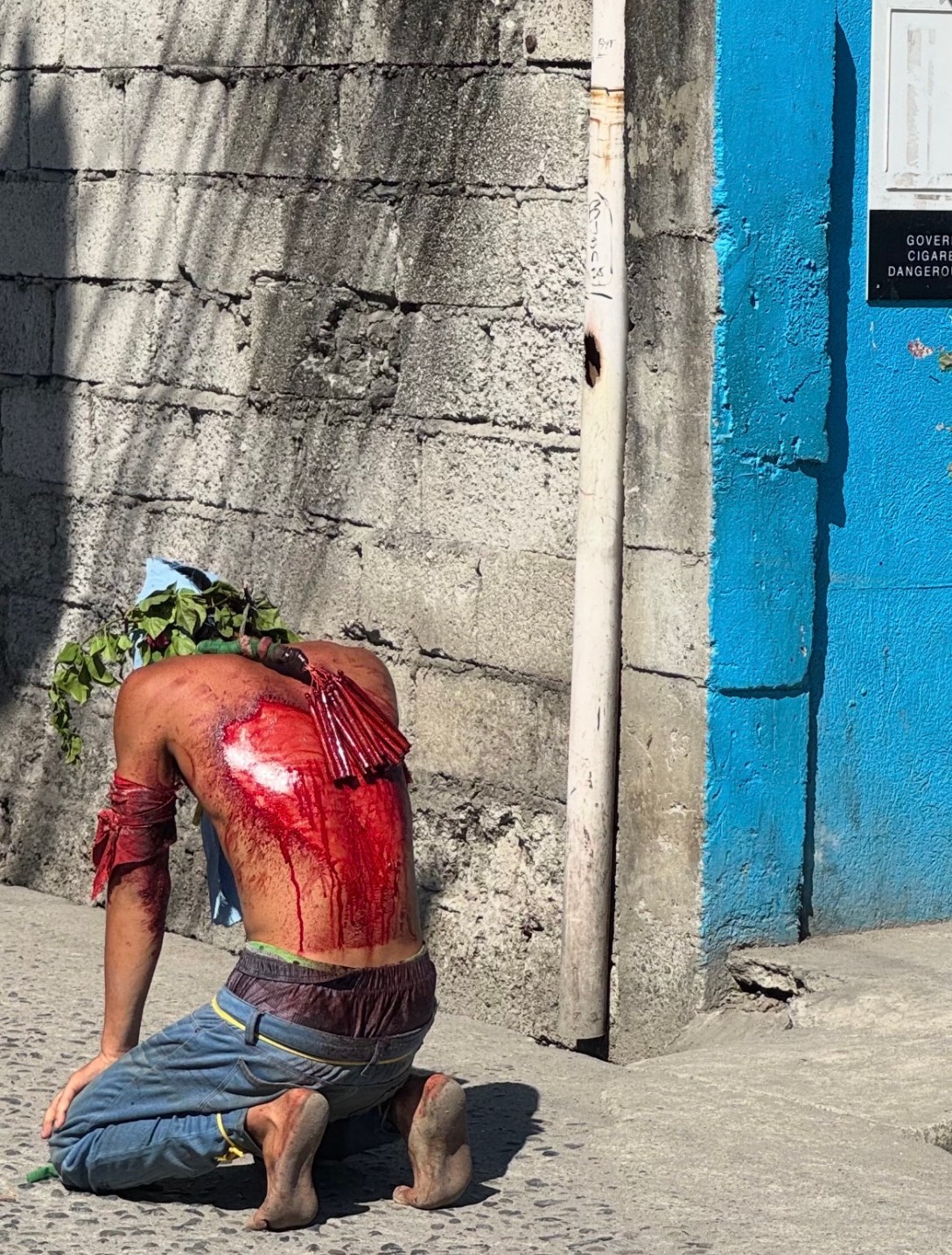
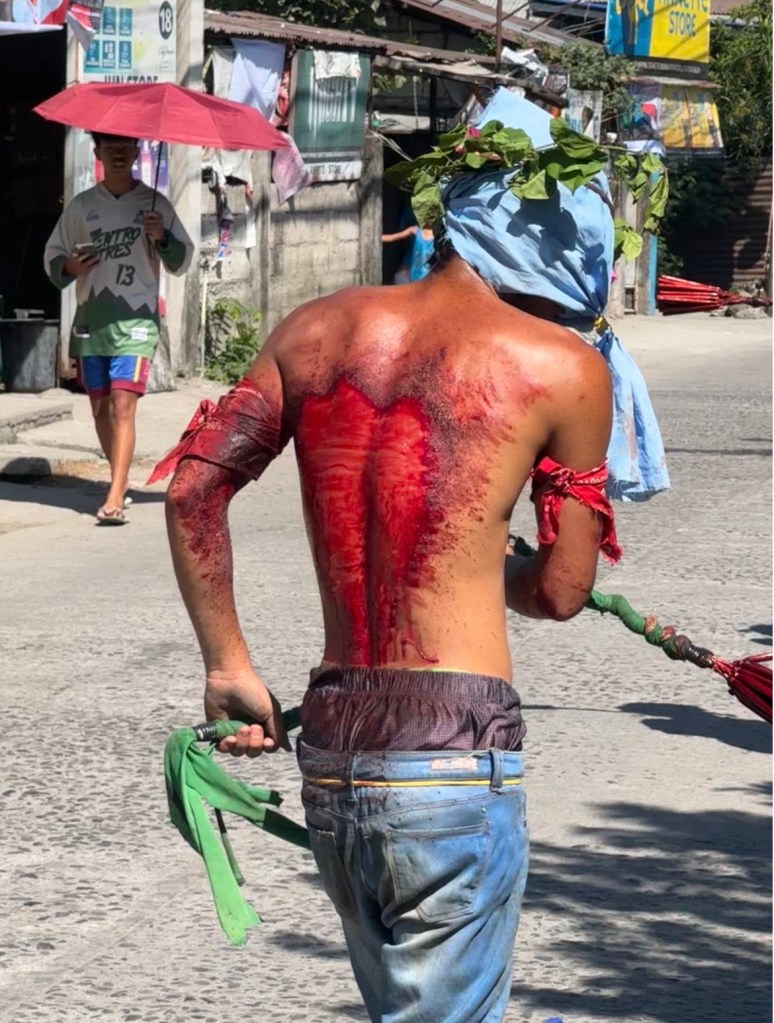
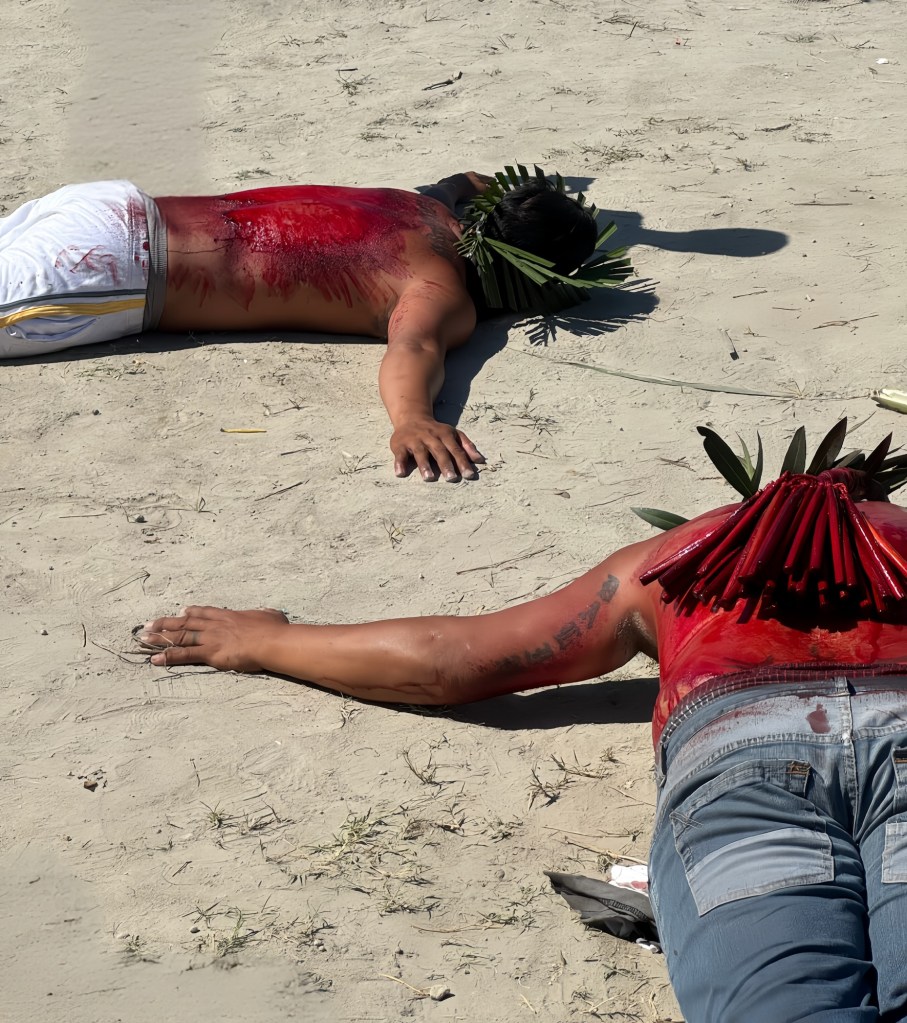
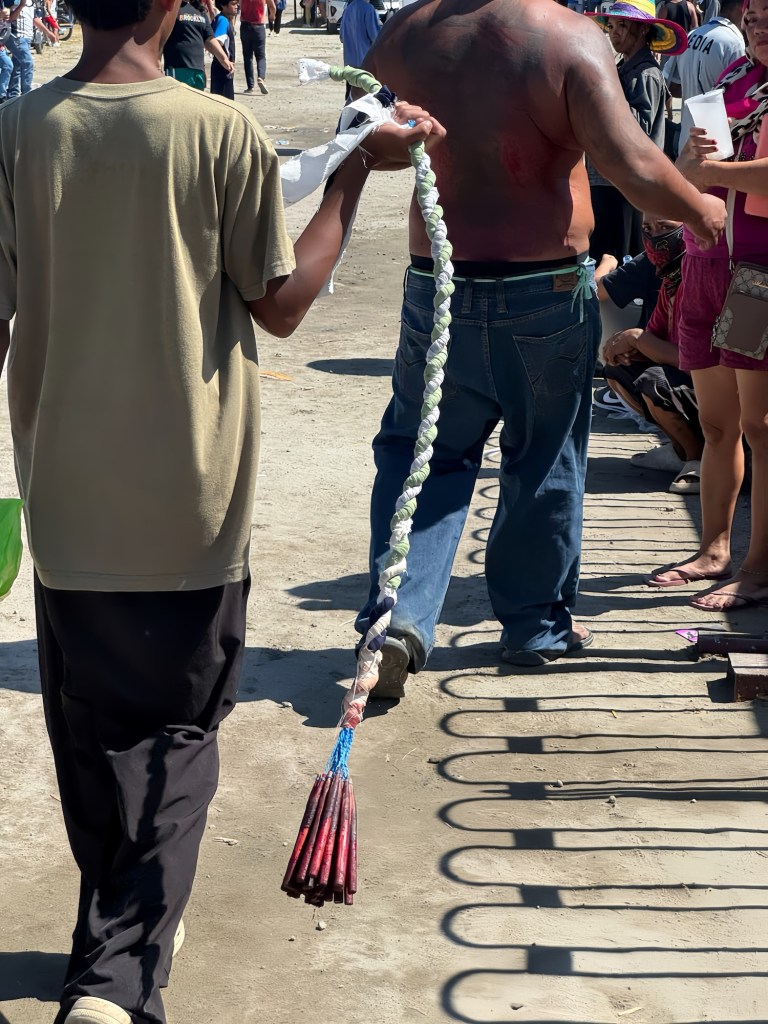
The Cutud Lenten Rites is a Catholic ritual, an extreme Passion Play, ongoing since 1955. The faithful walk barefoot through a village, whipping themselves, stopping to lie face down in the dust while a companion casually lashes them.
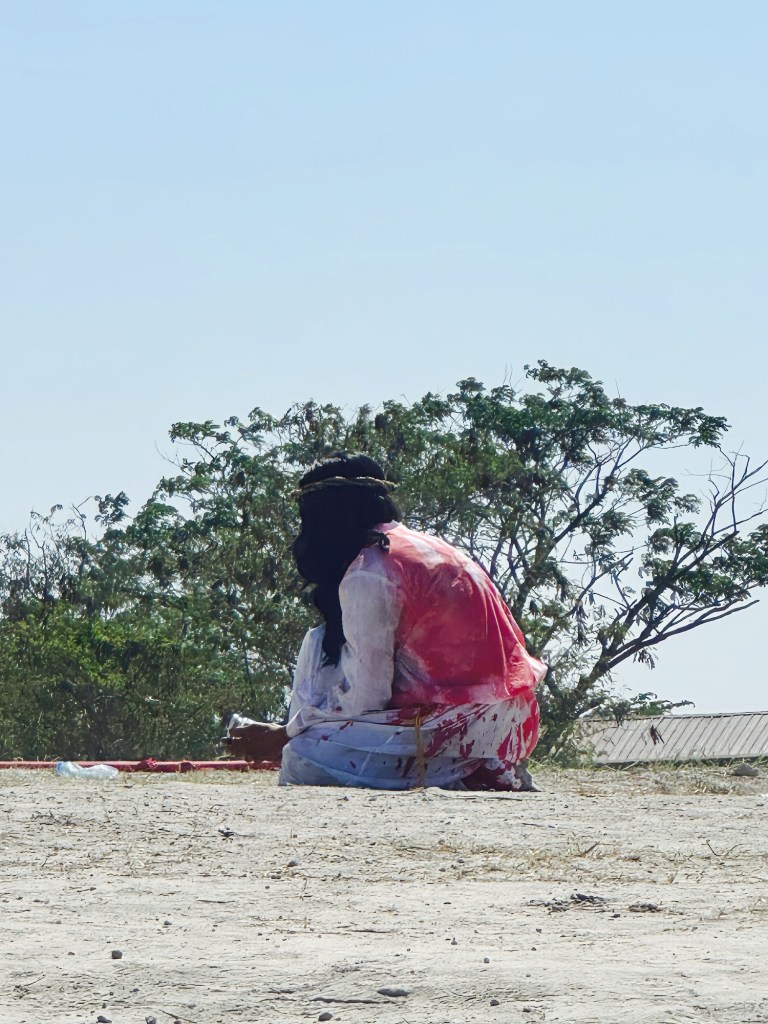
Others drag heavy wooden crosses. Faces are obscured beneath hoods, heads crowned with palm leaves and flowers. They move slowly along the main road from a church to a mound where three crosses stand, kneeling, prostrating, whipping, partaking in the suffering of Jesus.
And yet the mood along the route isn’t solemn so much as carnival-adjacent. Street vendors sell Pringles and SpongeBob balloons. Children scream with delight and insist on high-fiving the few foreigners, as if this were a parade rather than an act of penance.
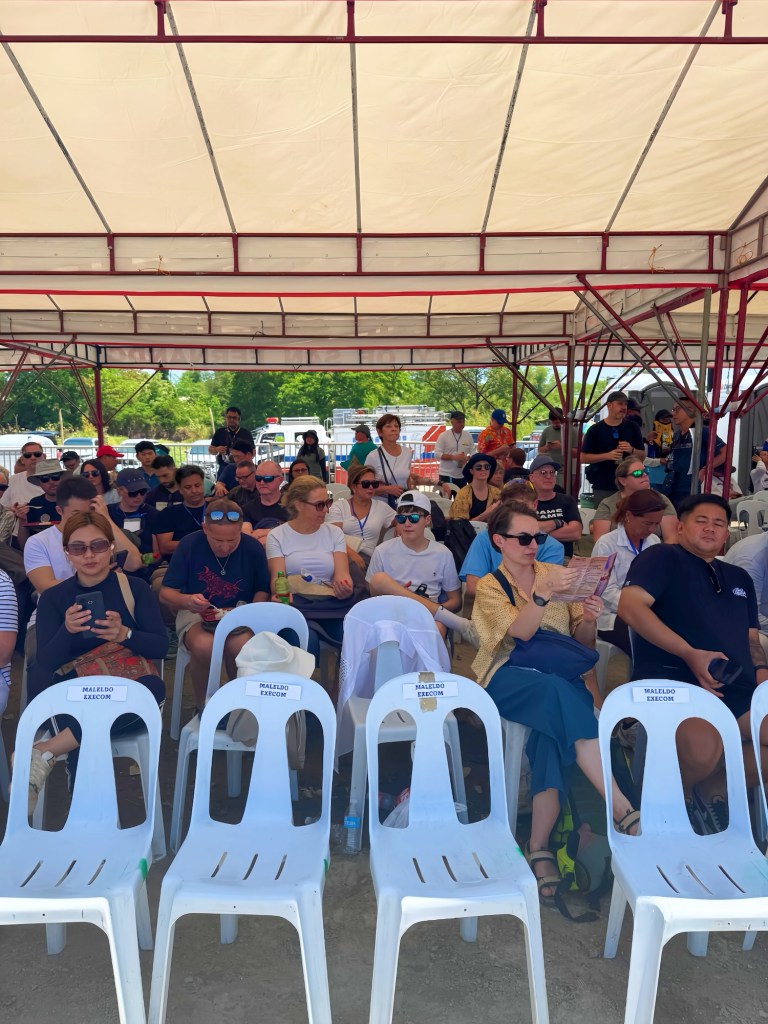
Back at the mound, we regroup under a marquee, VIP, apparently which feels a tad obscene given villagers stand opposite us in the full, punishing sun. We sit on plastic chairs, our water bottles cooling in an esky, while prayers and hymns blare through loudspeakers, filling the chaos with a relentless intensity.
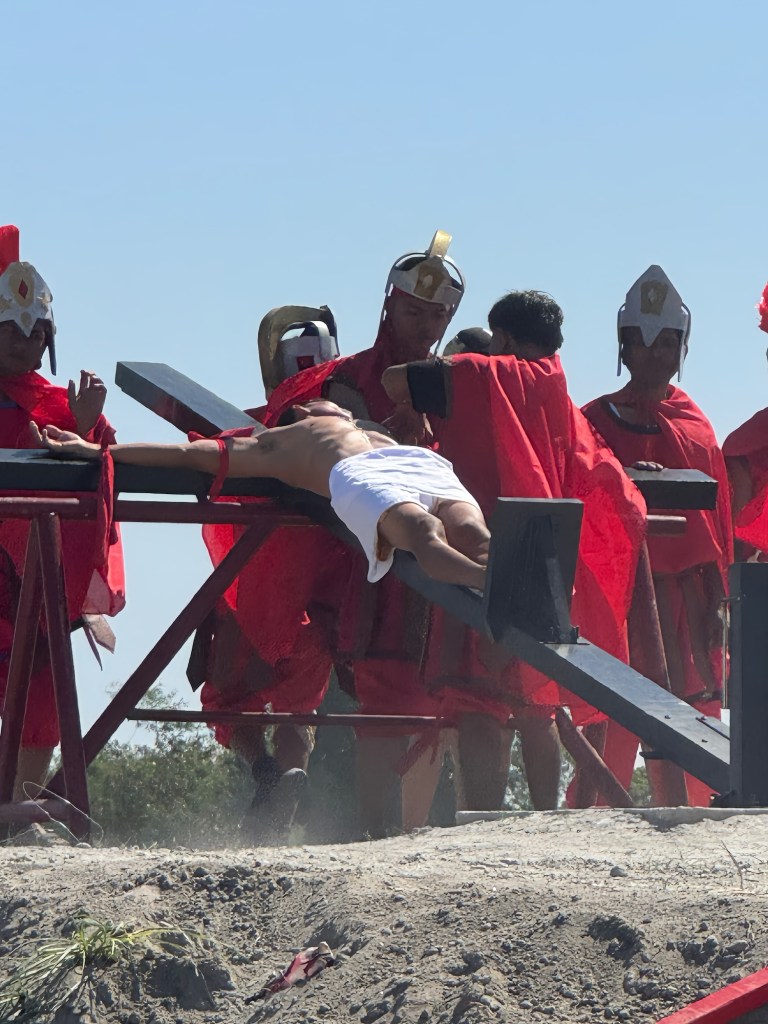
Around midday, the Passion Play begins: a re-enactment of Christ’s final hours. Actors dressed as soldiers jeer and strike, the figure of Jesus is put on the cross, the mourning women sound perhaps too convincing.
And then, almost seamlessly, the line between theatre and reality dissolves. The crucifixions that follow are no longer symbolic. Men volunteer to be nailed to the crosses.
At first, I feel shock, the blood, the violence, the intimacy of pain, the uneasy awareness of my own role in witnessing it. There’s no alcohol, no softening of the edges. It’s brutal. But later, something shifts. A creeping acclimatisation that feels morally suspect. I’m sweaty and blood-speckled watching a man on his knees be whipped, then nailed to a cross while I eat a bag of cashews like I’m at the cinema.
I’ve never felt further from home, wherever that is, or more aware of myself as an outsider. I catch the eye of a man holding a bloody bamboo whip, I don’t know whether to look away or acknowledge him, as though we’re participating in the same thing. Our tour leader asks if I want to buy a whip, do I? Maybe but it seems both impractical and inconvenient to carry the bloody thing back on the bus.
By the end of the day, the question isn’t what I witnessed but why I needed to. The answer could be curiosity or cultural interest or something much darker, neither option feels especially flattering but a far more compelling alternative to chocolate eggs.
For anyone who isn’t familiar with you, who is Pura Luka Vega?
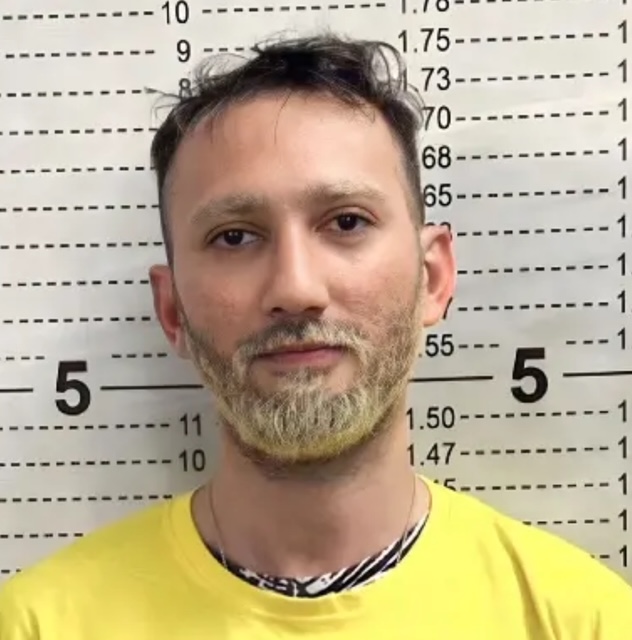
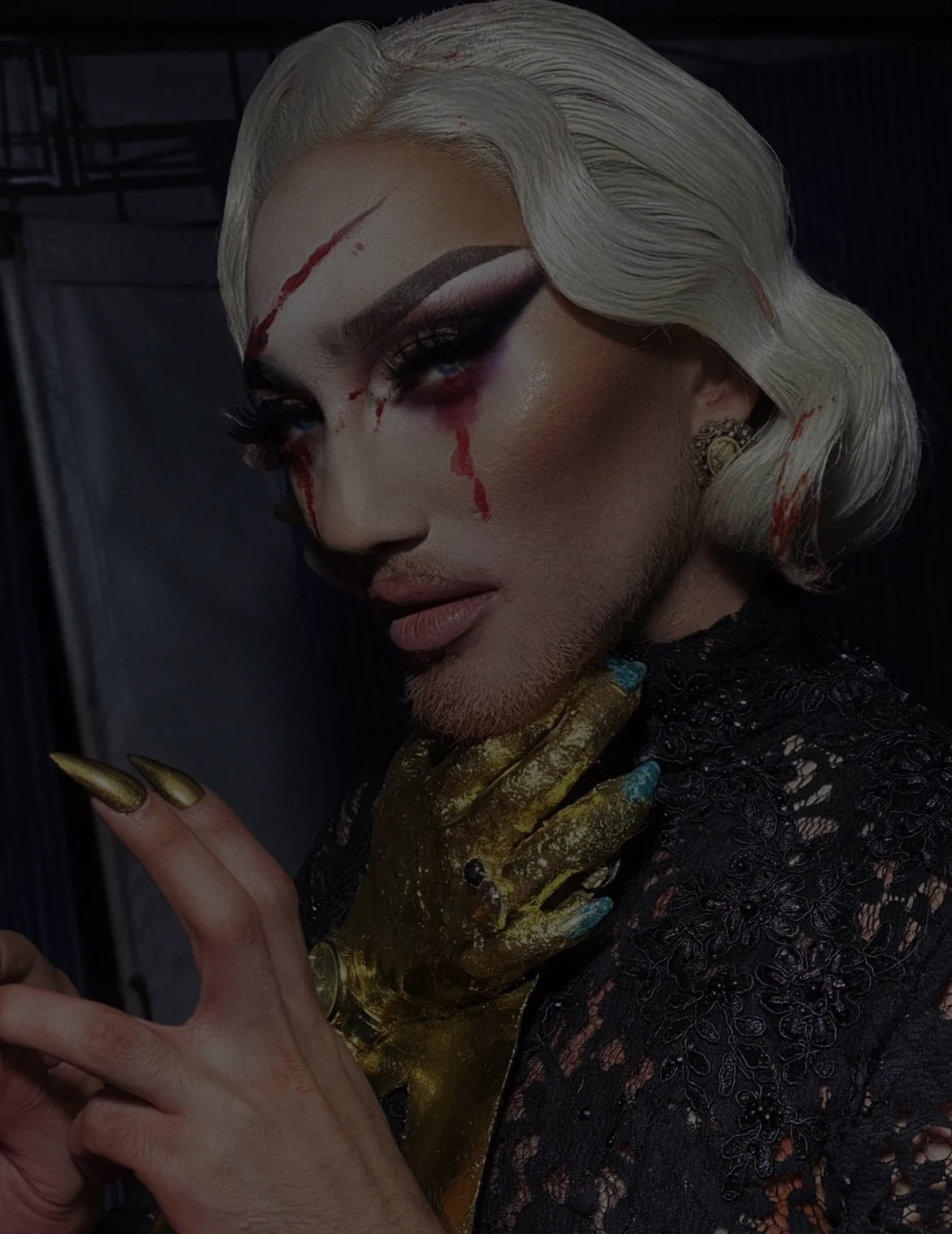
Drag artist, actor, writer, activist, comedian, model and author. I started doing drag in 2017. I became internationally recognized in 2023, I was arrested for dressing up as queer Jesus. It was a commentary on how religion was being used against queer people… we can be religious and queer and it was me taking charge of the narrative. I had a lot of death threats. Public figures got involved, some were disgusted, some amused. They filed cases against me for offending religious beliefs.
When I was arrested, the bail was huge, over a million pesos. I went to jail. It was a miserable situation to be in but I knew I had to stand up for freedom of expression for myself and for other queer people.
My cell mates were not bad people. They were victims of how society is. It made me realise that justice is sometimes only for people who have money. I was lucky, I got out of jail after 3 days, if it wasn’t for my sisters raising funds and some grants, I’d still be in jail.
Ironically, around the same time in 2023 on Drag Race Down Under, Snatch Game was won by Ashley Madison’s portrayal of a gay Jesus Christ.
Before the fame and the headlines, what kind of kid were you?
Weird. I knew I was different, I tried to hide it, “Conceal don’t feel.” I got comfortable with who I was outside high school. I realized it wasn’t going to be an easy life, the things that I aspire to aren’t within my access, like same sex marriage. In the 2000’s there was a rise in HIV cases in the Philippines but no one talked about it. I had a sense of dread, I am part of a community that no one cares about. The anti-discrimination bill still hasn’t passed after 30 years. Nothing has changed much, same sex marriage is an uphill battle.
Was there a specific moment when you realised that drag could be your medium for truth-telling?
When I was 27 I thought, “What would I do if I was a woman and I wanted to marry someone?” I designed a wedding dress, I made it, I bought a bouquet. So something I was not able to access in real life, I was able to access for a brief moment in drag. I was heartbroken over a breakup at the time, so I ruined my wedding dress in the performance, I had blood splatter over my heart. It went viral. After that, the bar owner asked me to perform as a regular.
Growing up in the Philippines, how did your cultural environment influence the artist you’ve become?
I grew up here but I was told I wasn’t Filipino enough because I look Caucasian as my dad was British. I had the attitude of “trying to fit in but not really fitting in, so why bother?” Culturally, I was very aware of our history, the colonial influence. Why do we have these beauty standards that do not celebrate people with darker skin colour? We have a lot of whitening products in the Philippines… why? We need to love our culture and identity, we lack loving ourselves… we were brainwashed for a long time by the Spanish and Americans.
Your performances have sparked conversations about faith and freedom. What does “religion” mean to you now?
Filipino birth certificates include “religious status”. So from birth, religion was ingrained in my system, my mum is a devout Catholic and I love my mum so I am also religious to a point. I grew up Catholic but also trying to understand other religions and what works for me. Now I am more universal in my outlook on faith and spirituality.
Do you see your art as a critique of religion, or as a way of reclaiming spiritual space for those who feel excluded?
It can be both. Our expressions of faith can be different but it’s all still valid.
You’ve shown immense courage in your work. What scares you?
Life is short. I want to live my life on my own terms. My fear is that people will tell me I can’t do that. I don’t want to lose who I am because of all the pressure in society.
How would you describe your fashion DNA in three words?
Eccentric. Liberating. Fun
You often blend Filipino iconography with avant-garde drag. What stories are you trying to tell through your looks?
Sometimes they are inspirations from what I see around me. My drag has always been a commentary on current affairs but it can also be just for fun. I dressed up as a banana, it’s the only fruit that has a heart.
Who are your style icons or influences, local or international?
My mother. Audrey Hepburn. Princess Diana.
What does fashion mean to you?
Self-expression. I try to have fun with it. Fashion shouldn’t be about labels, it should be an extension of who you are.
What’s currently on your playlist?
Rosalia. Sabrina Carpenter. Charlie xcx. I studied violin when I was young, I love dramatic classical musical.
What’s a song that instantly puts you in performance mode?
I love Kylie Minogue! But drag doesn’t always have to be upbeat, it depends what story you’re telling.
Do you ever feel like “Pura Luka Vega” has taken on a life of their own, separate from who you are privately?
Yes, I used PLV as a friend who was protecting me. So when my drag persona was being attacked I wanted to protect this version of myself.
Where did you get the name?
I started with “Luka” after the song by Suzanne Vega. “Pura” was the first Pageant Queen of Manila.
What’s it like when you’re on the stage?
Cathartic, I feel like I’m dying, I’m shedding emotions. I feel anxious and excited before, then when I’m performing, I just let go of everything, just be in the moment. When it’s over, I feel sad and drained which drives me to create something new.
How do you protect your inner peace amid all the noise, attention, and controversy?
I ignore what other people think of me.
What’s something about you that people would never guess?
I’m a bit of an academic. I have a Masters Degree in Health Social Science, I was a researcher and worked for the Government in the Department of Health.
What do you think is the next frontier for drag in the Philippines?
More diversity, more inclusivity. Women in drag.
If you weren’t performing, what do you think you’d be doing right now?
Working in the social sciences.
What’s next for you?
I have a comic book being released next month. It’s about drag and the realities of being a part of this community. We need to be visible so we aren’t erased, I will continue to perform, my shows are listed on my website artofplv.com
If you could say one thing to those who see you as an inspiration but may be struggling, what would it be?
Don’t be afraid to ask for help. Asking takes real strength.
The world can feel like it’s on fire right now. What do you think it means to be truly human in this moment, and what are your hopes for who we could still become?
Thank you for the wonderful question, very pageant! To be truly human means to feel connection, we’re all connected. We aren’t each other’s enemies, the stage is big enough for everyone. If we work together, we can put out that fire.
This is a beautiful studio space, how did you come to be here?
In 2021 during the pandemic, we encountered production problems between the design and workshop teams which were in separate locations. I had three criteria for a new space to house everyone, it had to be somewhere near to where I lived, nice enough for visitors and also affordable.
This used to be a pre-school. I had noticed it before and when I saw the rental sign outside, I had a look, it perfectly met all my criteria and it was L-shaped!
Can you describe Filip + Inna in 3 words?
Culture, Relationships and Hands. And Filipino Soft Power; when something innate to a country (like culture) becomes very appealing to other people.
Filipinos are recognised for their love of singing. If Filip + Inna were a song, what would it sound like?
Happy, lots of melody, the full spectrum of Filipino instruments. If I had to describe the composition of our song, it would be the sounds of the stories that go on behind the scenes.
How did the brand come into being?
I was diagnosed with cancer in 2000 and when you are dealt the cancer card, you have a fresh perspective,
“What if this goes down and I only have 6 months… I have to do something with a purpose beyond myself.”
I had taken up a Bachelor of Science in Clothing Technology and I knew I wanted to do fashion but I was disillusioned with the process of commercial fashion. The answer came in 2007 when I met textile designer John Robshaw in New York. In his studio was a book, he would circle villages around Asia and write the particular skill they had. That was a eureka moment for me, I realised I wanted to work with local artisans. I started the brand in 2008/2009.
Favourite piece you’ve created and why?
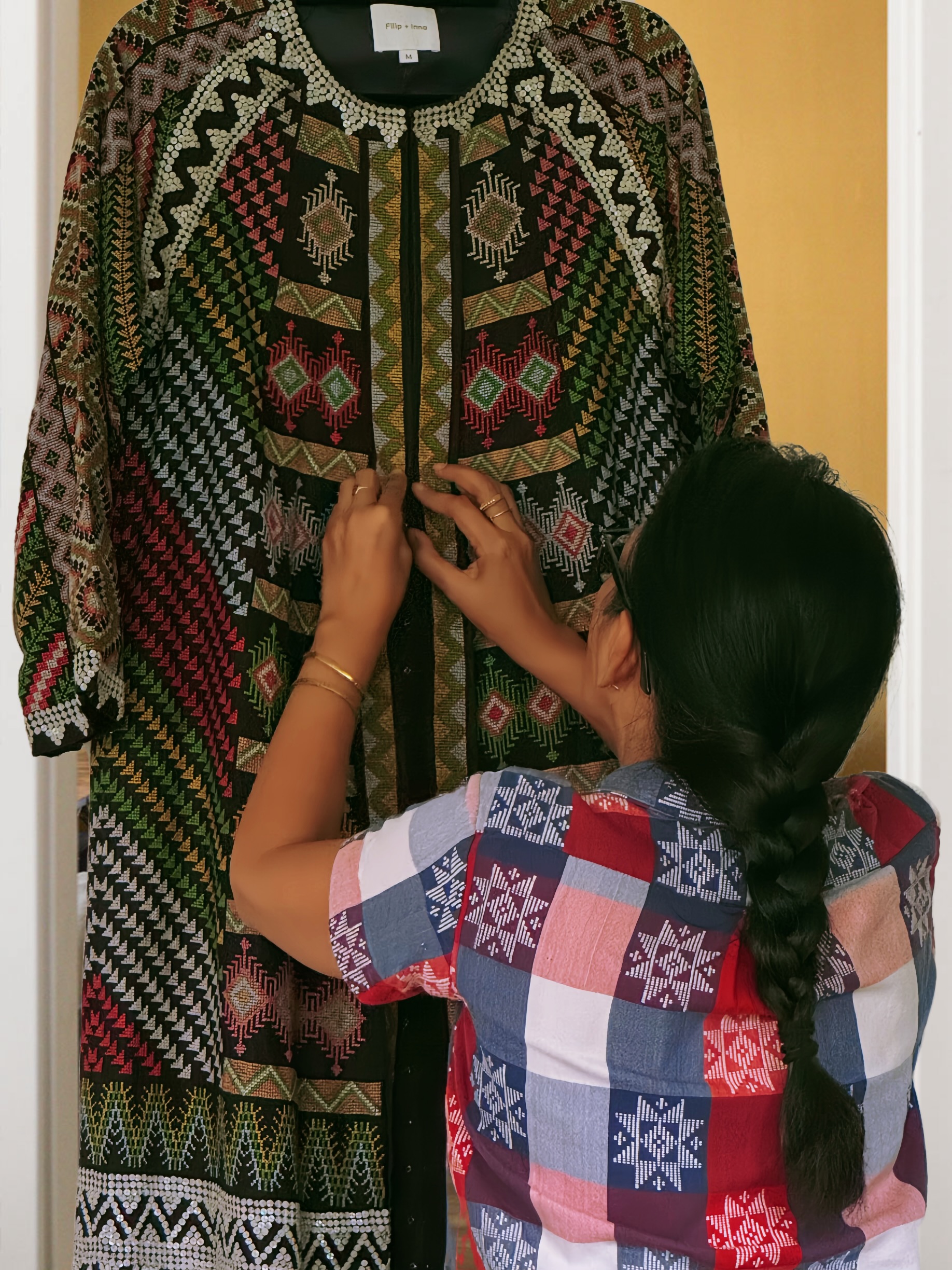
I have an emotional attachment to a coat by Carmen Kwatik. She passed away while she was working on it. I had become very close to her and her whole family. After she died, they sent me the unfinished coat. I couldn’t do anything, it still had her smell, the threads and the needle… After two years I felt a better way to honour her was not to just leave it in my closet but to have it finished by her daughters. People tell me I should sell it but it’s one piece that is really so special to me.
You work with artisans right around the Philippines. Which indigenouscommunity taught you something that changed the way you design?
Each group teaches you something and we adjust to how each group wants to create. When you meet indigenous artists in person and see their art, you can’t help but honour their creativity and be led by them rather than impose your designs upon them.
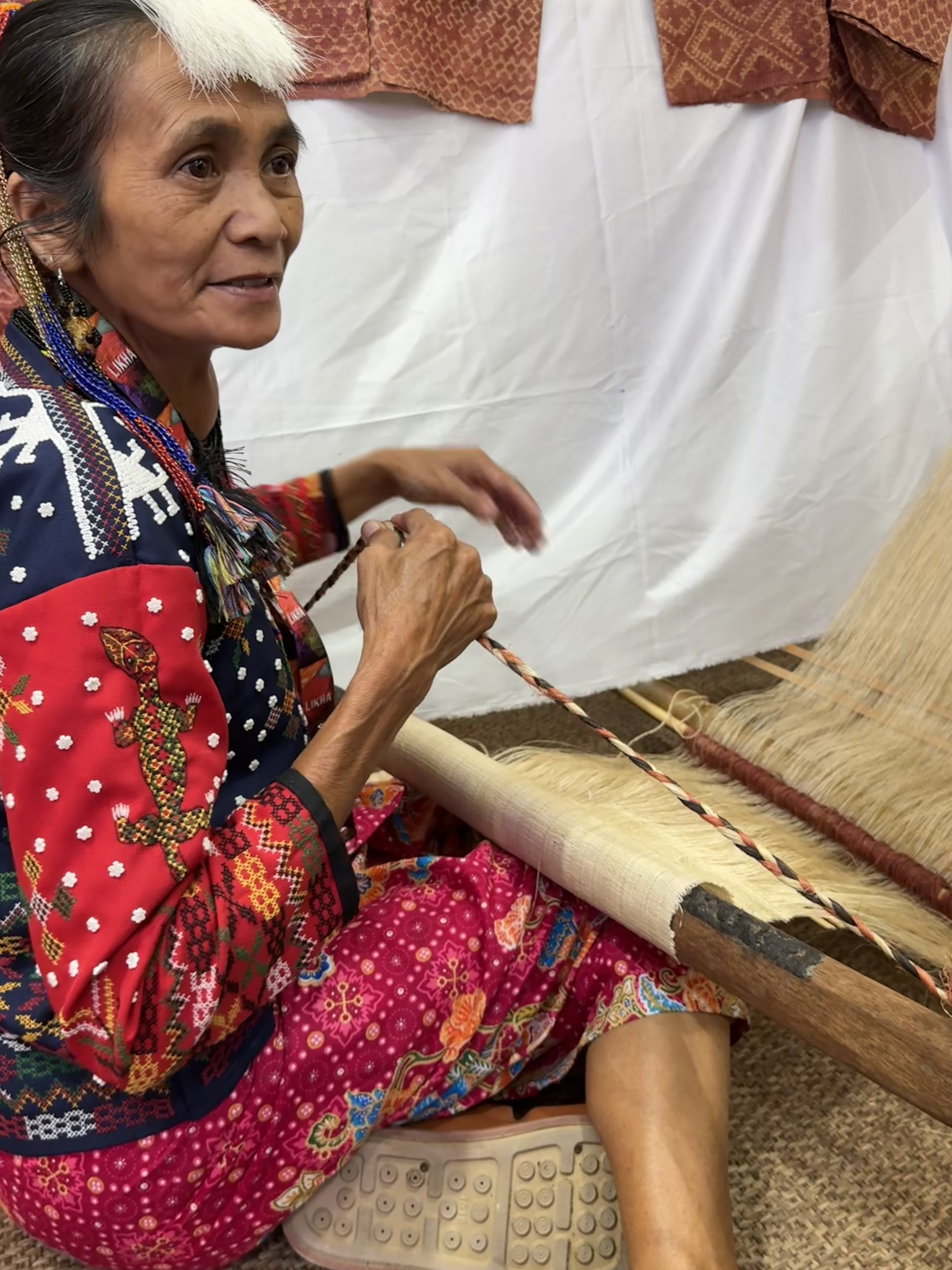
The indigenous T’boli women weavers use a loom to hand weave intricate stories on to textiles, traditional craftsmanship passed from mother to daughter. Can you tell me something you personally discovered about these National Living Treasures?
Firstly, their intelligence and creativity are astounding, when you see their patterns, it is so intricate, how what they see in their heads goes into a fabric… I so admire them.
I discovered that they love lipstick. Even though weaving is solitary work, like a meditation and they are already beautiful, they appreciate visual beauty and take pride in themselves, in their femininity. It is a very endearing quality. I bring lipsticks each time I visit.
Also, they are so affectionate. When I visit, sometimes they cry, I cry.
How do you balance working with artisans who work at their own pace and being commercial?
We adjust to their schedule, we tell our story, we stick to who we are as a brand and people respect that.
Which designers do you admire?
I had the opportunity to work with Inno Sotto and Jojie Lloren. Also, Ivarluski Aseron, Joey Samson and young designers like CJ Cruz, Gabbie Sarenas, Kelvin Morales, Renz Reyes, Steph Bagasao, Yssa Inumerable, Abdul Gaffar.
Whose style do you admire?
Talitha Getty’s bohemian style, Jackie Onassis in her A-line dresses, the androgyny of Christie Turlington.
Who inspires you creatively?
People I meet. And the artisans.
Who would you love to collaborate with outside of fashion?
Ceramic artist Edmund de Waal. I loved his book The Hare with Amber Eyes. His medium is porcelain, his finishing, the shapes, the muted colours, so beautiful.
If you were not designing, where would we find you?
Teaching pre-school kids.
What’s one thing people would be surprised to know about you?
I don’t appear sporty but I am. They say I have a good golf swing, it’s easy for me to get on a windsurf board, I like tennis.
What’s on your current playlist?
Cinema Paradiso for designing. Abba when I’m happy. Worship songs when I need to be hopeful. Depends on my mood.
Favourite city?
Tokyo. Everything makes sense. The Japanese are friendly but restrained. They take so much pride in their work, whether it’s the person driving the taxi or the way something is wrapped also how they preserve things, honouring imperfections and the work of the hands, craft there is still so much alive, I love everything about it. It nurtures my minimalist side.
What do you love about Manila?
The craziness of it, the people. I can confidently drive my car around and if I break down, someone will help me.
What’s your guilty pleasure?
TV series. I just finished Hostage.
What advice would you give to emerging Filipino fashion designers?
Start small. Focus on what’s on your plate. Don’t make comparisons with your peers, we all have different journeys.
What has been a challenging aspect of your work so far?
Always being careful and sensitive towards the artisans, trying not to offend, doing the right thing by them.
And a highlight?
When I started, working with artisans wasn’t a thing. There were designers working with craft in the context of high fashion but I brought it to a more accessible level. To now see, new brands rooted in culture and people realising that the value of craft is in its process, is so encouraging.
First pinch-me moment?
When I first started out, I was invited to do a trunk show in South Hampton. I had to send 35 pieces (my whole inventory at the time) and I didn’t know how to price my work. Back then, Tory Burch was the it-girl so I based my prices on her price points. I was just winging it but we sold 27 pieces. Later the organiser of the event invited me to join their trunk show in New York. I walked in jet-lagged and was introduced to a woman who was looking through my collection. She wanted to buy some pieces. I didn’t realise it was Tory Burch until later.
What do you want Filip + Inna to be remember for?
As the brand that worked with artisans in a way that really manifested in the pieces we created. I want us to be remembered us as a brand that honoured Filipino craftsmanship.
What’s one thing you still want to try – inside or outside of fashion?
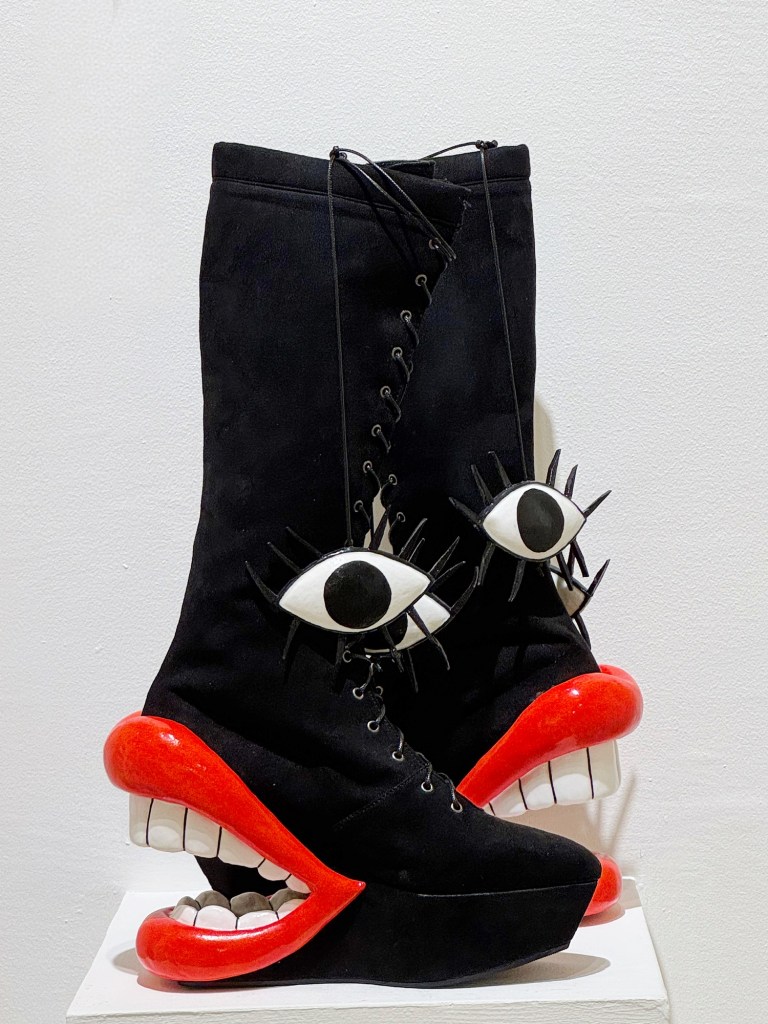
Step aside minimalism, Joel Wijangco’s latest footwear exhibition is a radical love letter to the Filipino psyche: layered, irreverent, nostalgic and alive.
G. If you could design shoes for anyone, who would it be?
J. Marchesa Luisa Casati, Isabella Blow and Daphne Guinness. The people I design for want to see a more romantic world.
G. What inspired you to design footwear?
J. My grandmother’s library was stocked with old Vogue and Harpers Bazaar magazines, as a child I would see these women dressed so extravagantly, it was just fascinating.
I started designing because I wanted to say something, tell stories and words didn’t seem enough. When I was 16, a friend in pageantry harassed me into designing stuff. As a gay, my heritage was to design for the pageant queens, all my gowns were like costumes and I always paid particular attention to the detail of the shoes. Then one day I designed over 700 shoes in two days. I’d always been a talkative child but the environment I grew up in was not very conducive to talking so the shoes came out like a flood of all the things I wanted to say.
Over the years it became more honed, I realised that Filipino stories haven’t been visible to Western or more privileged audiences. That’s why you’ll see a lot of very local or anecdotal designs, like fishwives at a wet market, pedestrian experiences.
G. What inspires you now?
J. It’s a more political point of view but still the same, like the wife in the Jeepney haranguing her driver-husband over rent which became the Mahadera shoe. The people on the jeep were laughing at this woman for nagging her husband, she doesn’t want to but she is forced to, if she doesn’t who will pay the bills?
I think society forces women to play villain roles if they want to be heard, women who talk too much or are too opinionated are seen as crass or lower quality here. Now when I make shoes, it can’t help but have that thread of dialogue.
G. Why are Filipino’s so obsessed with footwear?
Shoes are expensive, we are very status driven, we like our status symbols. Society is tight-knit, we create this hierarchy of who’s doing better because then it affords a certain status and maybe a feeling of being entitled to better treatment.
For me, it started with my grandmother. I was terrified of her. She had a closet full of shoes and there was something beautiful about them, my shoes were always cheap and ratty, hers smelt nice, she had a lot of Ferragamo pumps and she would travel to the fashion houses like Chanel. One day she came home too early and I had to hide under her bed. She started walking around her room, I could see her feet in a nude pair of pumps and there was something about that felt very triggering, maybe it woke something in me. It felt removed from my reality, it felt aspirational. I also noticed that she looked different when she wore the pumps, her carriage was different. And the women in the fashion magazines looked different. I grew up with the maids, they wore slippers and they didn’t have this aura. These women felt otherworldly.
G. A great shoe should make you feel…
J. Complete.
G. What’s on your playlist at the moment?
J. CocoRosie. I also like some Taylor Swift songs and classical music like Claire de Lune if I want to calm down, Moby for drawing and Gladys Knight. I have a varied musical playlist.
G. What’s the weirdest place you’ve found inspiration?
J. When I was 8 years old, my father would take me to the wet market, the women there were not like my mum or grandmother who were small and skinny, they occupied a lot of space, they were very loud and that was very frightening for me. I disliked the wet market environment, the mud between your toes, the noise, the smell… it was overwhelming.
G. How would you describe your aesthetic?
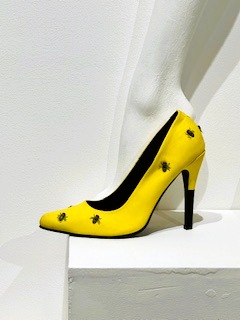
J. People have called it camp. It’s also humorous. Some of it tends to be dry, some of it is vulgar. The Nilangaw is my favorite, it’s a simple pump covered in realistic flies. If you go to lunch or a charity event and your feet are covered in flies it looks like your feet smell or you stepped in something. It happens, especially for people who can’t live in beautiful suburbs. It’s dark humour, I like humour it’s part of the human experience to find things ridiculous.
G. How does it feel to walk into your own exhibition?
J. I’ve done exhibitions in India but this is my first local one. I have a tendency to second-guess myself, also, once you start drinking your own Kool-Aid that’s when your material becomes artificial. I am scared of that. I don’t want to call myself “artist” because I don’t know if I’ve earned the right to it yet.
G. Which footwear designers do you admire?
J. From a design point I love Moschino. Louboutin cornered the market on sexy. Blahnik, Loewe, McQueen. Carolin Holzhuber, she makes me feel small. I go for magical realism and hers are like brutalism, so on the other side of how I see things, it totally boggles my mind and I just love her for that.
G. Which emotion is the hardest but most rewarding for you to translate into design?
J. Grief because people don’t wear these shoes and be like, “Oh I want go out and be sad.” Grief is something that you process. It’s one of the hardest because it’s painful. Anyone who has lost somebody doesn’t want to live through that again. I have a shoe about grief that I haven’t made yet.
G. What do you hope people will feel when they see your work?
J: Delight. If not, unsettled.
G. How do you stay true to your heritage and still appeal to an international market?
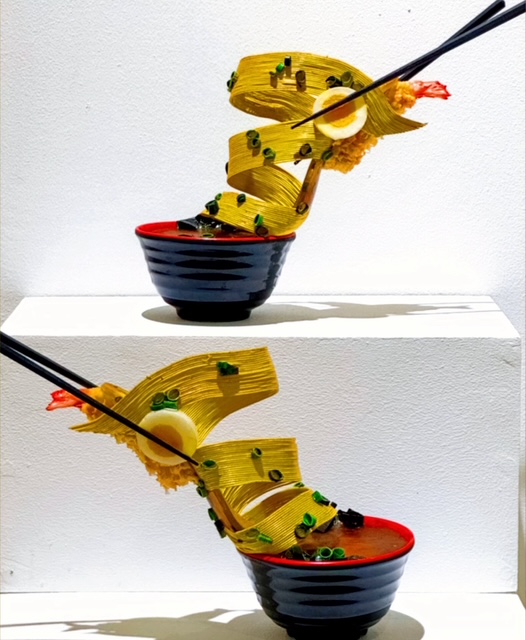
J. I’ve been criticized for not making Filipino-looking shoes because their idea of Filipino shoes is using Filipino textiles. I didn’t grow up with that but all my experiences are Filipino. The nuance escapes some people and they go for low-hanging fruit which is the visual element. I was cyber- bullied for the Sister’s Favorite which is the ramen soup, I was called race-traitor because it wasn’t Filipino food but it didn’t bother me. Ramen was my sister’s favorite, she was a teacher in Japan, if it had been Sinigang, I would have made a Sinigang shoe. She had cancer, a daily reminder of mortality over her head and I wanted to do something to cheer her up. When it came out, she cried.
G. Which designer would you most like to collaborate with?
J. Moschino, they are always poking fun at fashion. Loewe for their sense of dryness. McQueen talks to my goth heart. Louboutin if they’d have me, they are very beautiful shoes.
G. Most valuable lesson you’ve learned from a mistake or setback?
J. It pays to have experience, if you don’t, seek professional input. Some of these shoes cross disciplines – special effects to industrial engineering – it pays to have an expert.
It’s difficult to put a cost on my shoes because there’s different kinds of workforces involved. I understand why the arts is mostly populated by the rich, going through R&D, it’s expensive especially if you make mistakes. It makes me feel more learned after going through it.
G. Which part of the Filipino culture has been misunderstood or underappreciated by the fashion world?
J. We’re very amiable and the fashion world is all about being opinionated. We’re afraid to rock to boat, we want peace but sometimes this comes at the cost of our own freedom or identity. It’s how we’re wired which is a reason why I might be unpopular because these shoes are very opinionated.
G. What do you love about Manila?
J. Despite the poverty, it’s alive, it’s colourful, it could be sad but it’s not. It has a personality, nothing gets Manila down, we always find a way to find joy.
G. If you had 24-hours in Manila, what would you do?
J. I like the fringes of Manila, like Malabon where I grew up. The old Spanish houses, they are mostly abandoned now, inside there is so much beauty left behind and so much beauty eaten up by the salt of the river, age and neglect. It’s very romantic, gothic. Also, the food is amazing.
G. When you design, do you begin with a feeling, a memory or form?
J. I have to feel something.
G. How do you translate something abstract like a feeling into a physical form?
J. My nanny was flirty, she wore skimpy outfits, she wore rouge on her face, sometimes she’d have dalliances with the driver. She was treated with scorn by my grandmother. I loved her, she was nice to me and this translated to the Kulambo shoe (mosquito netting) as she used to lull me to sleep inside the netting in her room.
G. You’ve gotten a lot of attention from the exhibition. What’s next for you?
J. I want to do a homewares collection. And wedding gowns. And I want to create an installation that puts you in my shoes so you know how it feels to be a child of abuse and neglect and part of a marginalised group.
I think people are ok with the marginalisation and violence against LGBTQ people, we all live in separate realities and we are unable to engage with each other. Which is funny because social media is supposed to connect you but it serves to create walls in communities and we’re unable to extend empathy to others. It’s painful to think about it. I don’t understand the whole cruelty thing. Our hearts are big enough.
G. What sustains you?
J. Hope. It makes me feel like I can survive another day. When people lose hope, they resort to violence. It’s overwhelming if you are a person in a developing country who is not privileged, you already have to deal with so much shit, then on top of that you see these other world problems. Hope sustains me.
G. Tell me about the BOHO shoe.
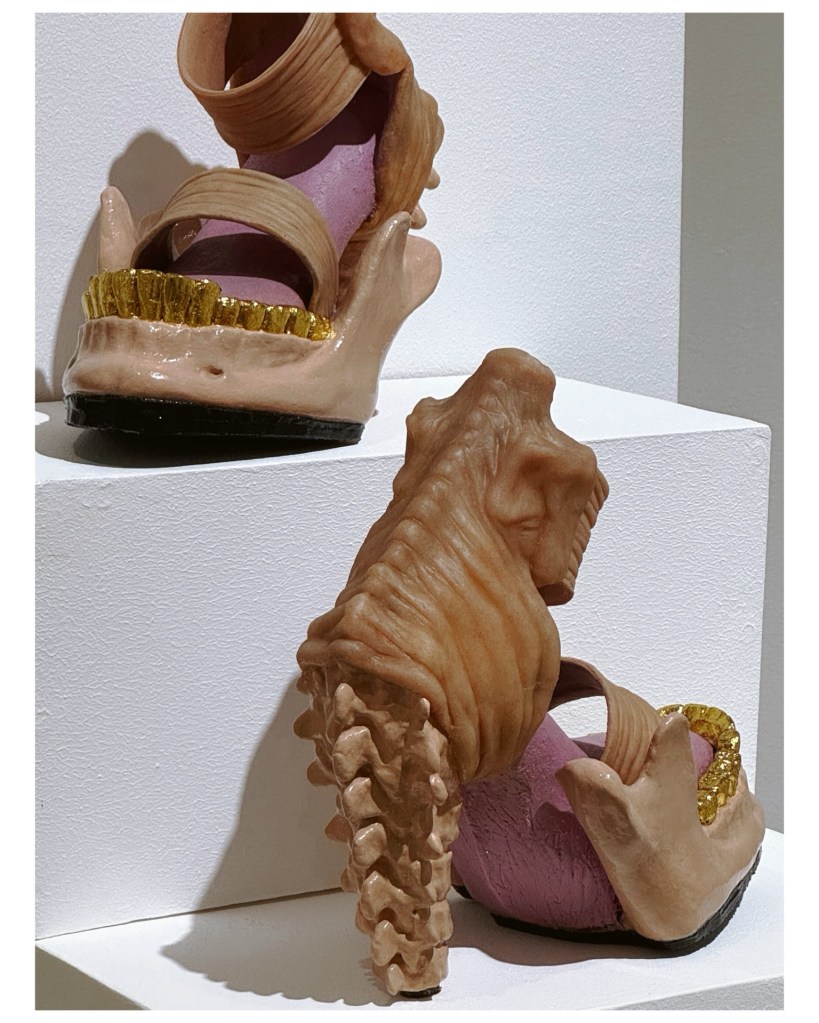
The bone shoe. This was my eating disorder. You don’t know someone is going through any disorder unless you get close enough to understand what they are going through.
The gold teeth represent stomach acid staining the teeth yellow but because this is fashion, it’s gold. Nothing goes hand in hand with eating disorders like fashion. It’s a heavy shoe but you get used to the discomfort of the weight after a while, you normalise it. Like the disorder.
G. What’s the worst part of bringing your ideas to life?
When people ask me about the price of my shoes, it’s like a live-wire in my chest. I can’t discuss price, it makes me defensive, it destroys me. It’s hard to link commerce with art. Commerce wants to understand how you came to this price, art is like, “I don’t know, I just felt like it.”
I can design for other people, but for myself, it’s harder. It’s more personal and when they are sold, it feels like allowing my child to be fostered, you are giving a piece of your soul away.
I don’t know how to sell, I just want to make my shoes.
G. What’s something that no one’s ever asked you but should?
J. Am I ok?
G. Are you ok?
J. I’m hopeful.
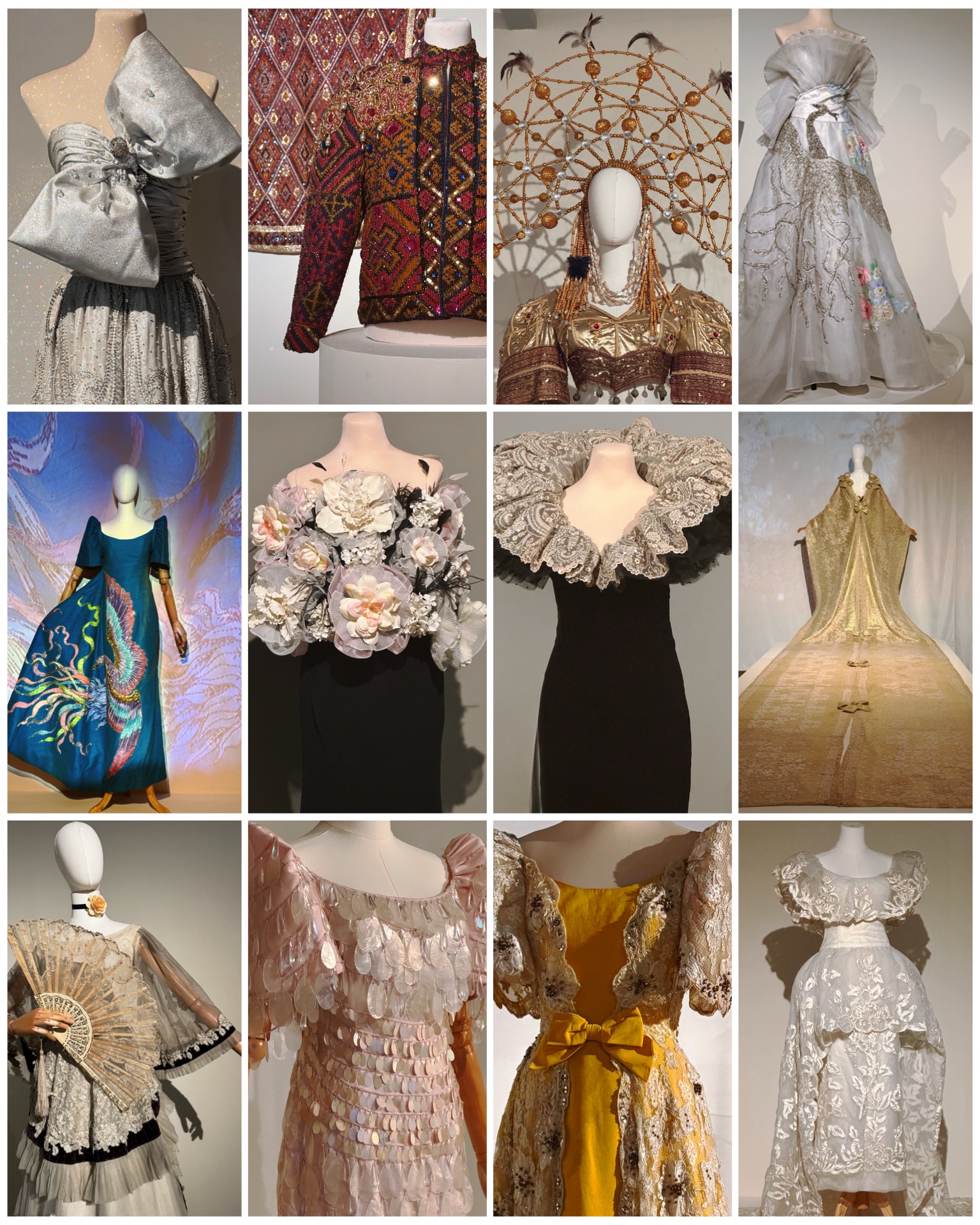
art2wear on at Yuchengco Museum, Makati until October 2025
The heart of living art, more than history, an archive of Filipino craftsmanship, creativity, and ingenuity.
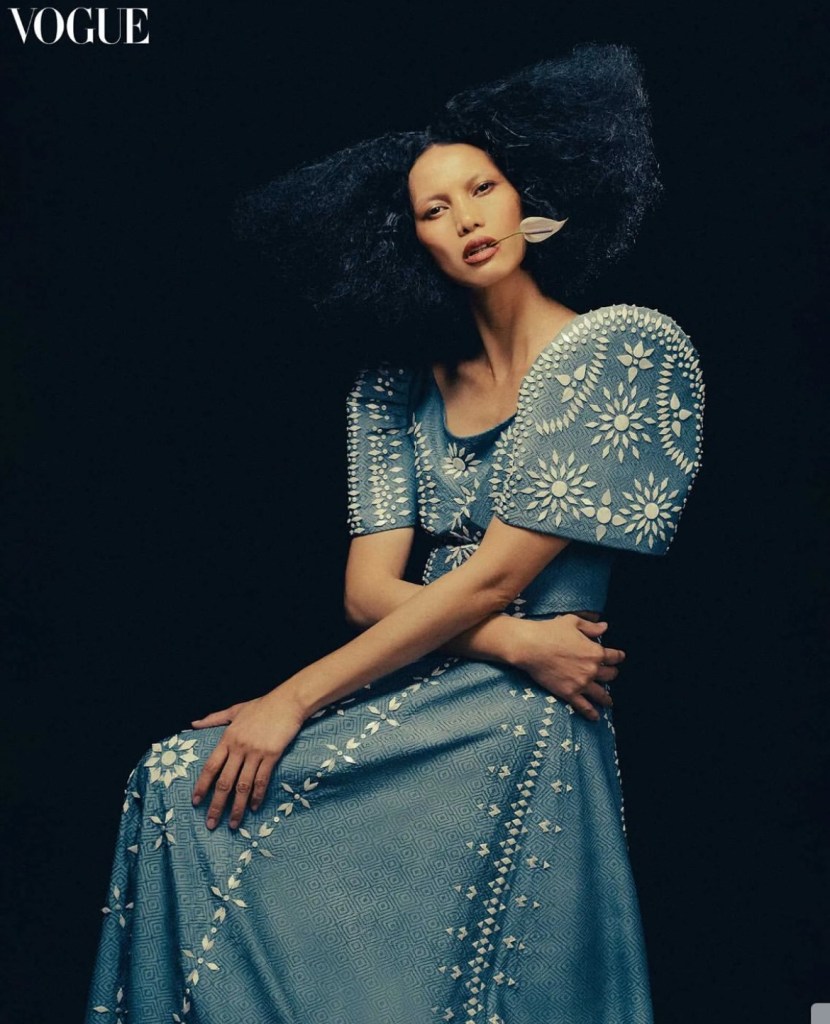
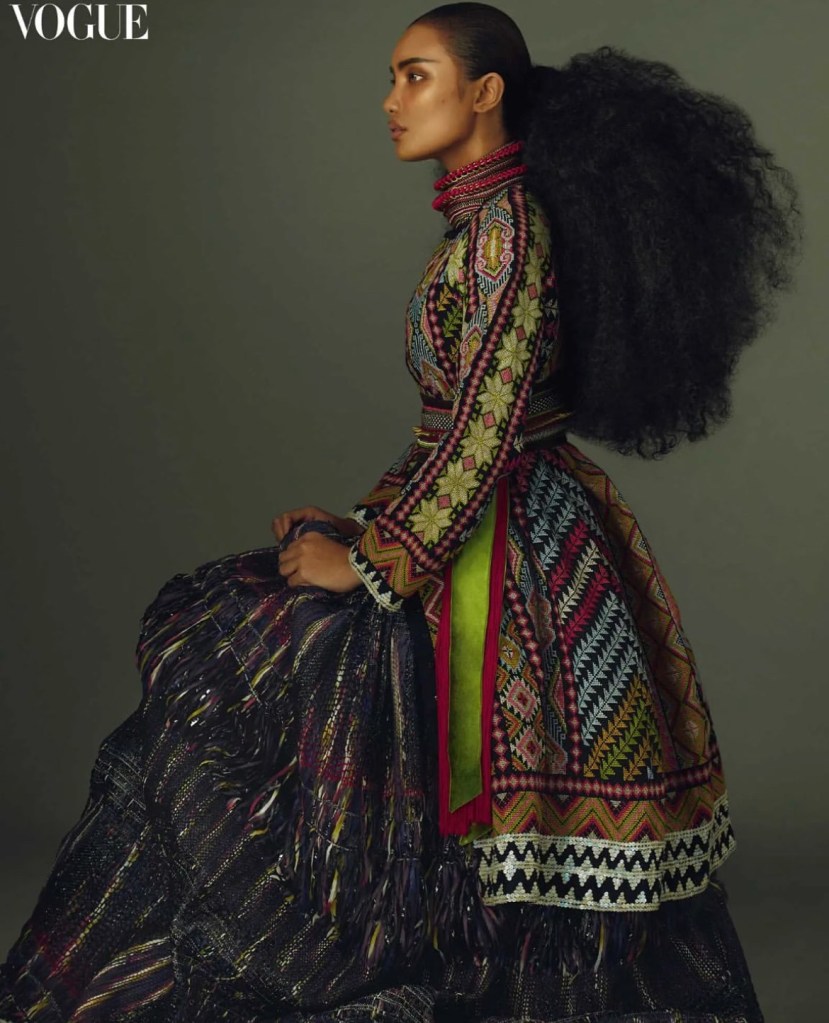
Introducing J. Moreno, the Filipino couturier whose pieces speak of lineage and ritual, silhouettes that live somewhere between fashion and artefact. His work is exacting, evocative, quietly radical, a masterclass in heritage worn with intent.
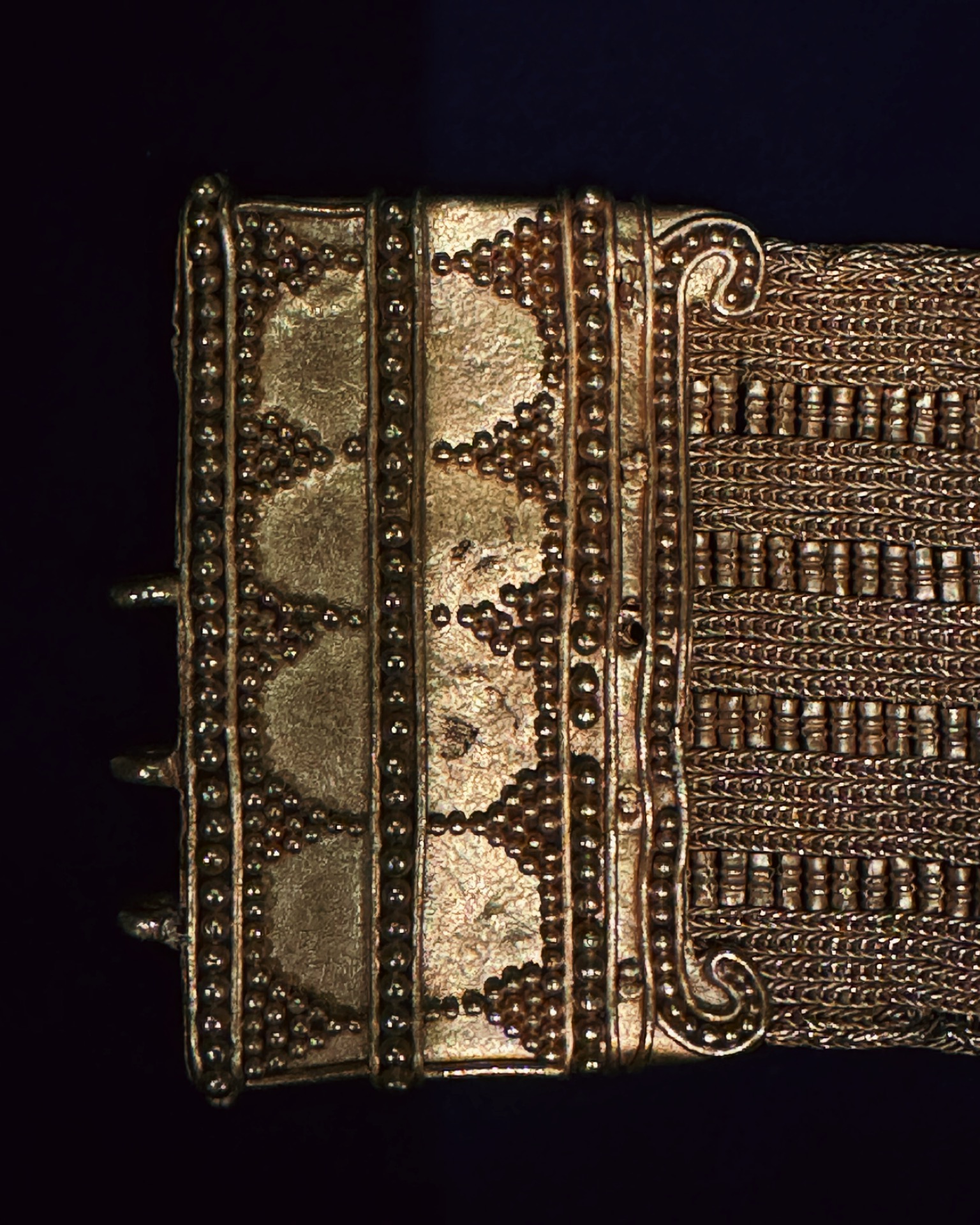
The Ayala Museum’s gold collection redefines ancient luxury, showcasing the extraordinary skill of Filipino metallurgists and affirming that refinement and ingenuity have long been part of the archipelago’s cultural DNA.
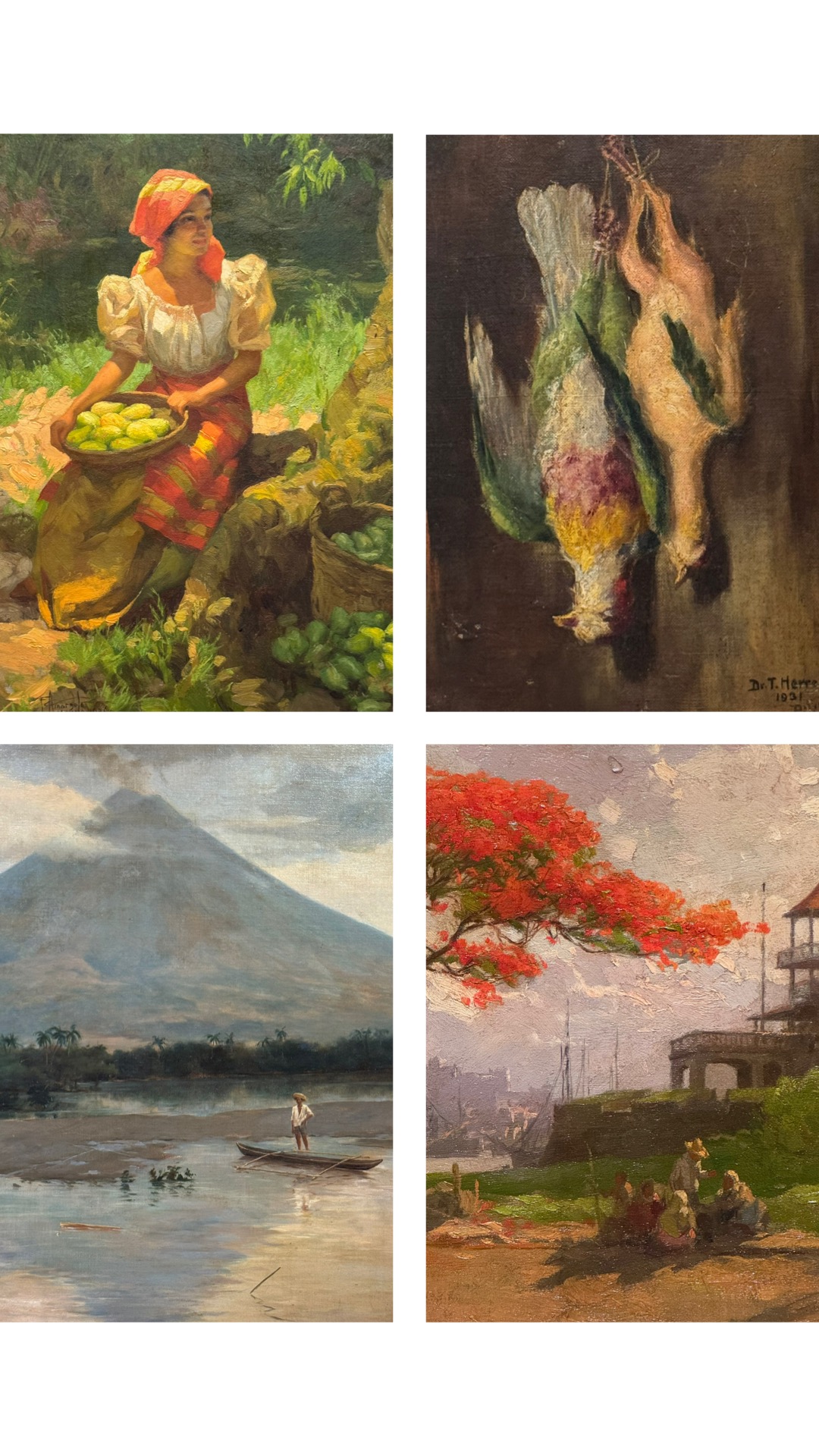
Featured, too, is the abstract brilliance of Fernando Zóbel, whose compositions feel as architectural as they are emotional and the luminous works of Fernando Amorsolo, whose sun-drenched rural scenes remain an enduring ode to nostalgia and national identity.
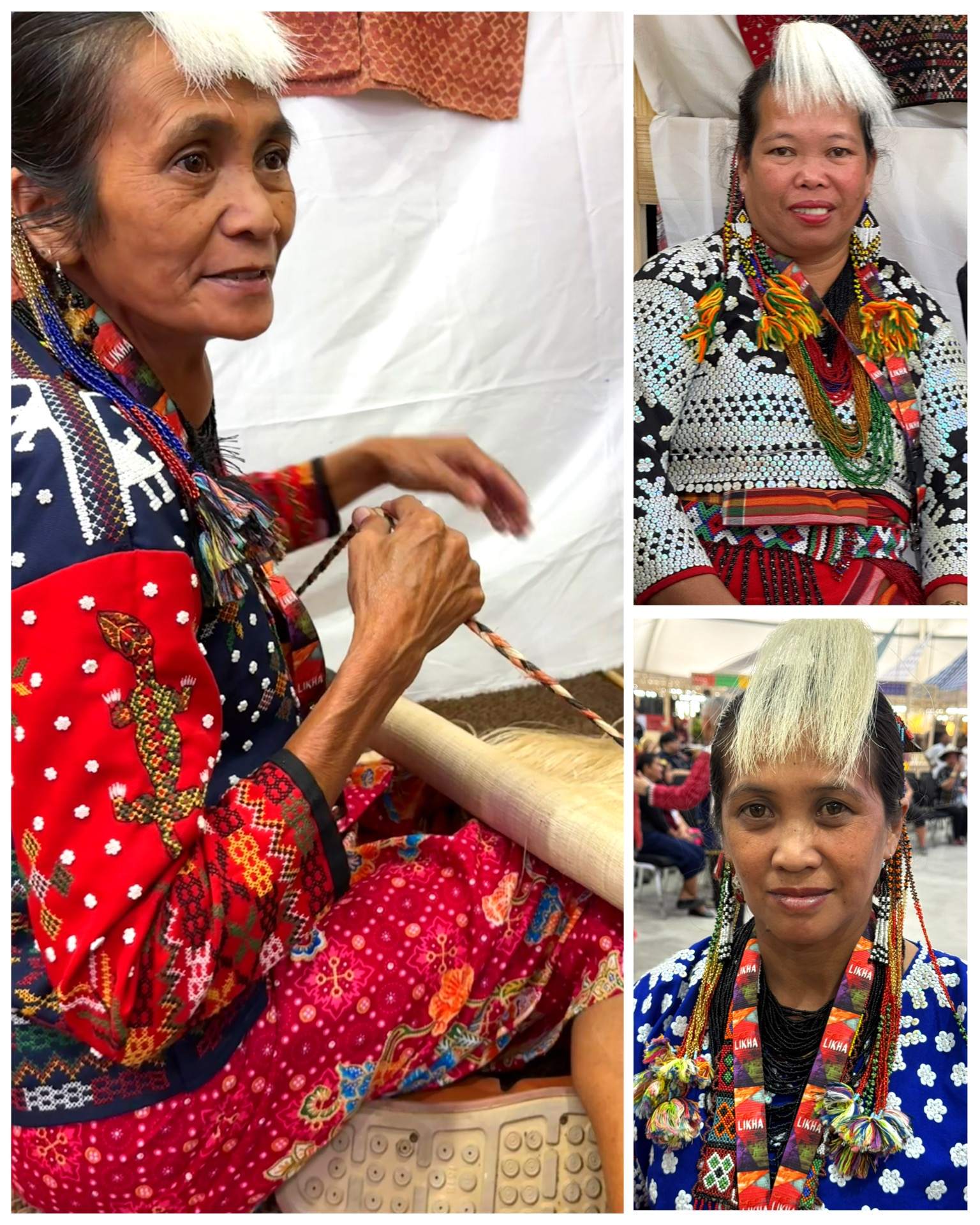
And then there are the Tritik Weavers of Sarangani, women whose hands still weave heritage into being, just as their ancestors have for centuries. Each textile is a quiet act of preservation, each pattern, a story told in thread.
In the Philippines, art is not frozen in time. It breathes. It adorns. It resists. It evolves.
Enormous thanks to Lizzie @filipinna for opening the door to this extraordinary world.
Chatting with Rikki Dank, founder of Lajarri an Indigenous Australian art gallery in Dubai, junior Nimaryngki and her David and Goliath battle to end fracking on her Country.
G: Tell me about this photo.
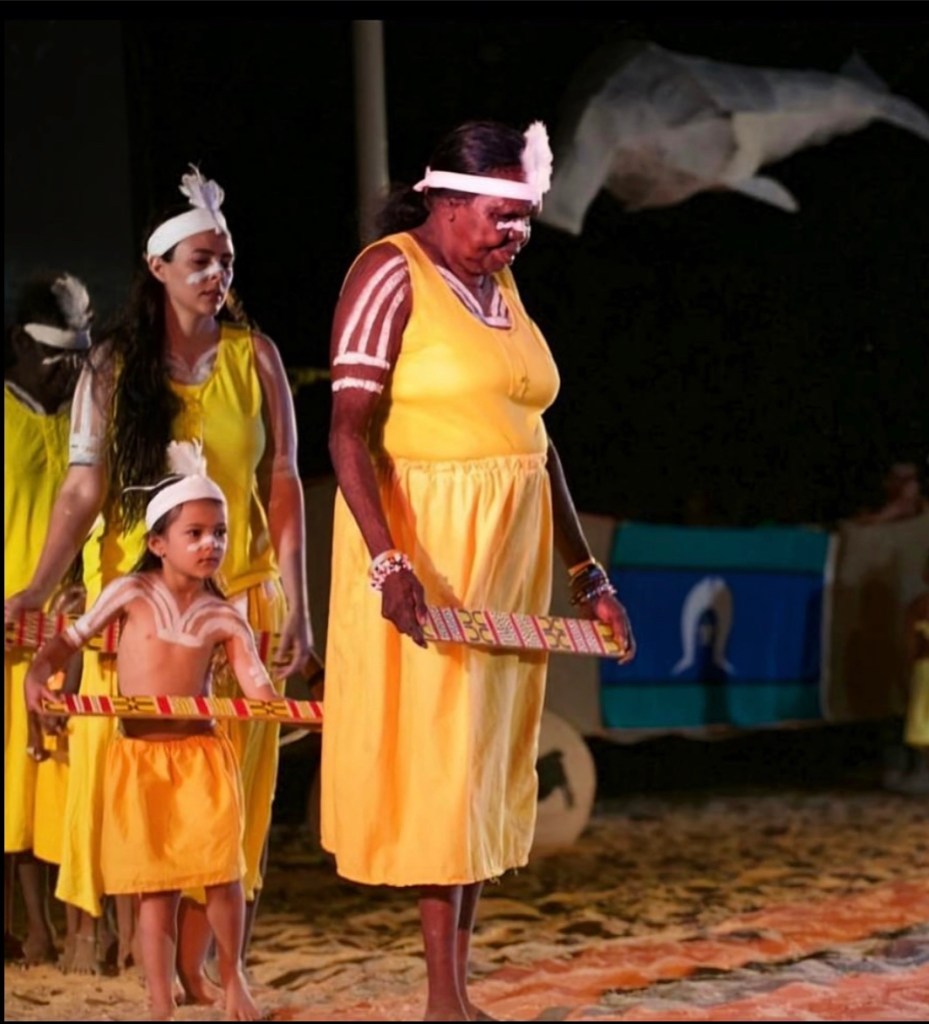
R: We are Gudanji/Wakaja people from the Barkly Tableland in the Northern Territory of Australia. Our land is Mermaid Country or Womens Country and my grandmother is our senior Nimaryngki (boss). She also looks after traditional dancing and medicines for our family. That’s why she’s dancing up the front. There’s not many of our clan left. A lot of our people were murdered or shot. I remember once feeling bullets in my great grandmothers back and not knowing what it was. We don’t carry the anger, it’s still grief.
G: What brought you to Dubai?
R: I came to the Middle East to get out of my comfort zone. As a woman, I felt safe in Dubai and I loved the diversity of peoples. I brought my family over for a holiday, they liked it, so we decided to move.
G: Can you tell me about the art scene in Dubai?
R: Diverse but thriving. There’s a hunger here to develop and nurture the arts. Dubai is easily accessible to the world, some of the biggest international art fairs in the region are here which benefits established artists and collectors looking for emerging or new talent.
G: How is Australian Indigenous art perceived in the Middle East?
R: Speaking generally, it isn’t well known but that’s changing as the market matures. When I explain the symbolism behind the art and that the stories are thousands of years old, people’s eyes light up, there’s a connection, it’s exciting to see that.
G: Professionally, what are you are you proud of?
R: Lajarri was the first Indigenous Australian gallery to exhibit at World Art Dubai. I bought our art to the Middle East.
G: You have a degree in nursing but you went on to open an art gallery. Why?
R: I did a course when I was 14 which taught me the basics of running a gallery. I had this dream but never thought it would be possible, I thought I should do something sensible so I studied nursing. When we moved to Dubai I saw an opportunity, there was no one else showing Indigenous art.
G: Which Indigenous artist do you admire?
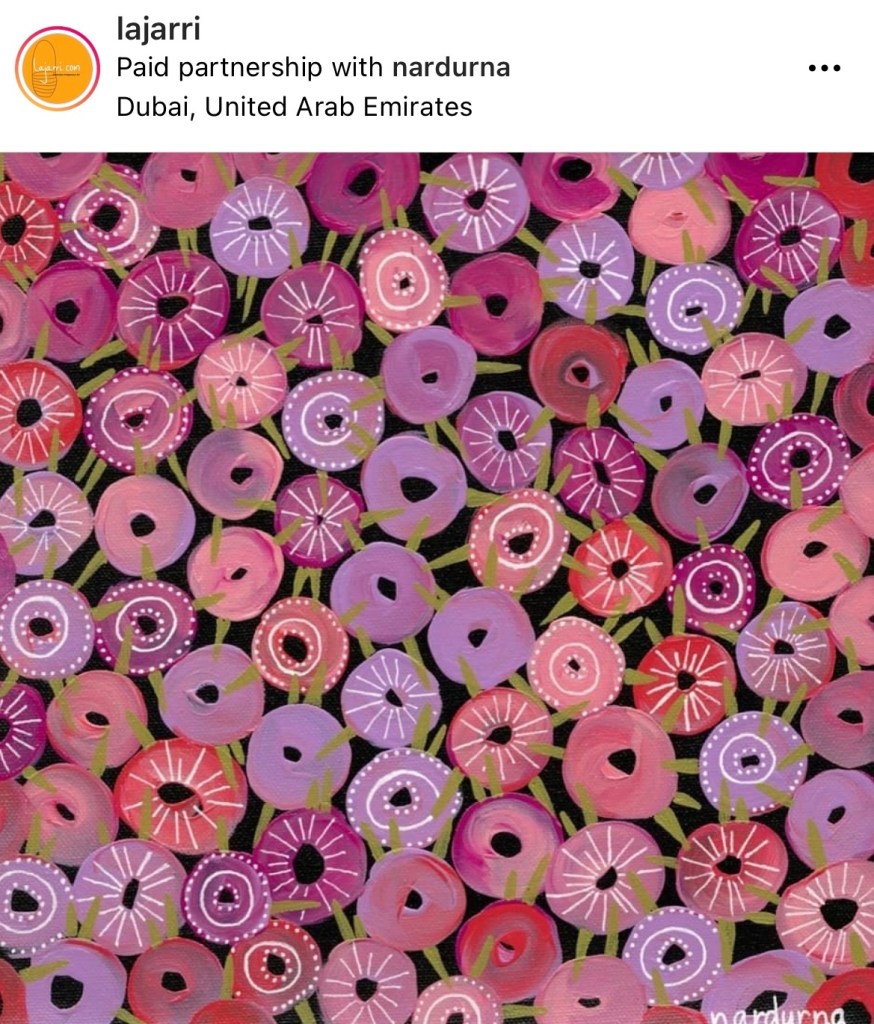
R: Nardurna, my sister. The quality of her artwork; she takes time selecting colours and working out placement, it’s all calculated in her head but it appears effortless. To see her succeed as an artist and business owner is lovely. She has it all together because she works so hard.
G: Did you ever want to be an artist?
R: In high school I won prizes for my paintings and I exhibited in a regional gallery. I still paint but I don’t, at the moment, feel that I’m good enough. I have an artists block which I suppose is what a lot of artists struggle with sometimes. I do dabble but not seriously because I dedicate my time to the gallery and other projects. Maybe down the track I will start up as an artist again…
G: You attended the United Nations Climate Change Conference Summit recently. Why?
R: I went to raise international awareness around what’s happening on our land.
G: What’s happening on your land?
R: One of the largest gas fields in the world is being built on our land without our consent. And down the road is a lead and zinc mine.
G: Why is this important?
R: Fracking and mining poisons the environment; our water has high levels of zinc, fish are dying and people are getting sick. My family have lived there for over 65,000 years. Once our country, our song lines and sacred sites are gone, well that’s it, it’s gone for good, you can’t get that back.
G: How do you see this playing out?
R: I’m hopeful but I try to stay in the present moment and focus on one thing at a time. Native Title law is really complex, in essence the new laws will allow oil and gas companies to come on to our land and frack and Traditional Owners will be cut out so we won’t be able to object. It’s going to be a big long fight to get these laws changed.
G: What do you do in your spare time?
R: (Laughs) I’ve got an 11-year-old daughter and normally my husband and I are so tired that we watch Korean dramas on Netflix. My two dogs seem to enjoy this too!
G: What do you miss about Australia?
R: Family, going out bush and the laid back beaches. I also miss the sausages, rotisserie chicken and pasta salad from Woolies!
G: What don’t you miss?
R: When you’re a person of colour in Australia, you always feel like you’ve got to look over your shoulder and keep your guard up. We even get followed by security when we enter some stores. I don’t have to do that in Dubai.
G: What three things would you love in the future?
R: My daughter to speak fluent Arabic. A big gallery near Alserkal Avenue (Arts District) to represent Australian Indigenous art. And to go home without seeing my grandmothers upset about issues on their land.
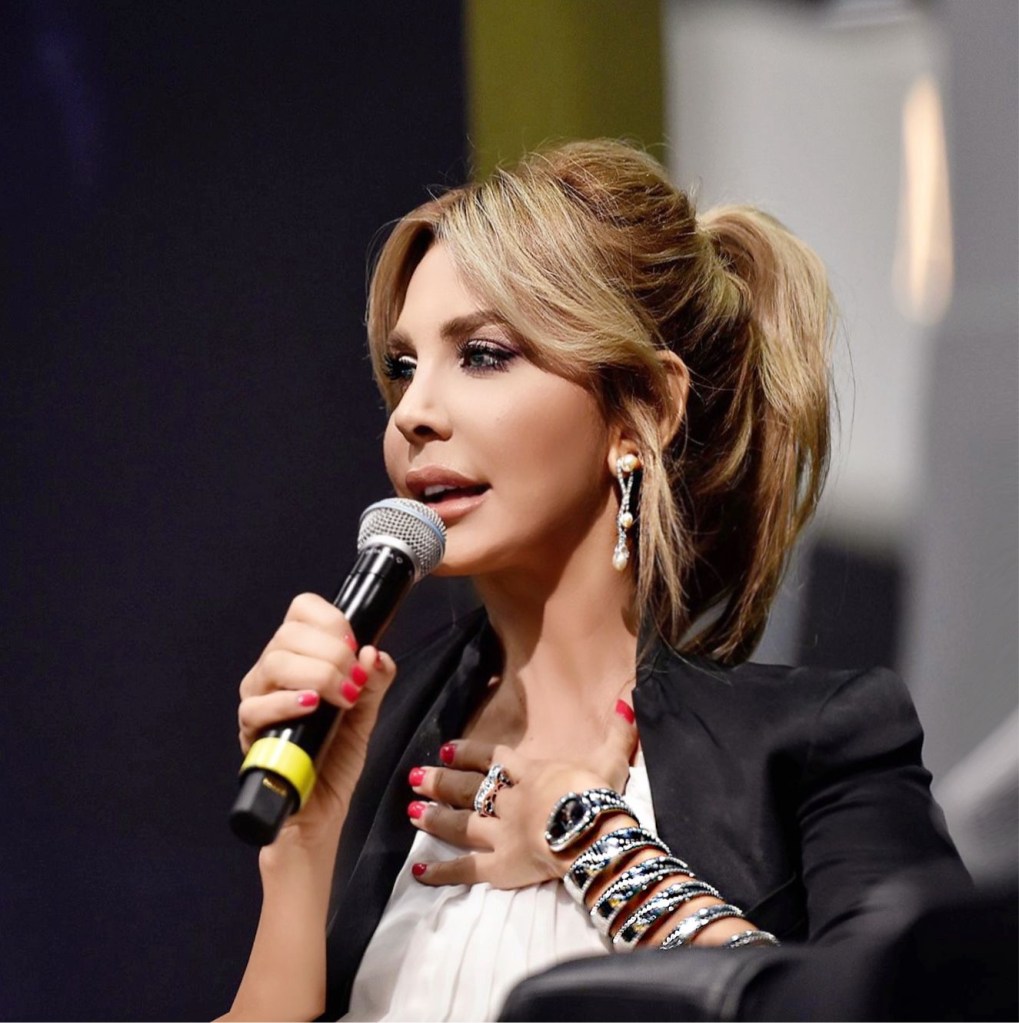
Nina Zandnia is one of the most accomplished women in media in the Middle East. Of Swedish descent, Nina grew up in New York and has worked across Europe, Australia, Asia, America and the Middle East. Now based in Dubai, she speaks 6 languages and holds a Masters and an Honours degree in Media Broadcasting and Media Law.
This powerhouse is a director and producer, a television and radio presenter, a Managing Partner at social media company Emiras, she writes a lifestyle column for luxury magazine Villa 88, she recently joined the United Nations (UN) as an ambassador and speaker and now, this mother of two, has plans for a project in Saudi Arabia.
G: You’ve worked across television, radio and print media for 2 decades. Why do you think you’ve been so successful?
N: I knew what I wanted to do from age 14 when I hosted a children’s tv show. From there, my career took off and everything I did was to get me to where I am today. I worked very hard, I was determined, I didn’t take “no” from anyone if it was a project I really believed in. If one network rejected my idea, I’d go to another and another. Also, I love what I do, work is my passion.
G: Did you have a role model or someone who inspired you?
N: My father. He always encouraged me with my career ambitions, even when I was studying and working abroad. Then Christiane Amanpour. As a female journalist reporting from war zones and her interviews with world leaders, she is fearless, clever, she paved the way for other women in the media.
G: Career highlights?
N: In my twenties I created a tv series called Top Dog. No one believed in it, there were no series about dogs at that time, it was a huge risk but when we finally produced it, it was sold to 36 countries around the world. Also, when I opened the first online lifestyle channel in the Middle East called LifestyleDubai.com. It had over 2 million viewers in less than 6 months.
G: Obstacles to success?
N: I didn’t have autonomy over the decision- making process, the networks did. I’ve encountered sexism my whole career but it didn’t hold me back, I went in stronger. Also, a network stole my concept for a show, it took 3 years in court to be compensated.
G: What attributes help to make a successful woman?
N: Self-esteem, self-respect.
G: What kind of person are you teaching your daughter to be?
N: Kind, respectful to others and to herself, genuine and to pursue something she loves the way I always have.
G: Pros and cons of social media?
N: Cons. Social media gives everyone a public platform to vent their anger, hatred and misinformation with no filters on what they say. Pros. It has such a great international reach, it raises awareness and connects us. I like to share my life, family and adventures and when I do post, I write from a place of kindness.
G: How do you deal with the haters?
N: I feel super sorry that they are such sad soles. Why else would you harass people on social media?
G: Tell me about your role with the UN?
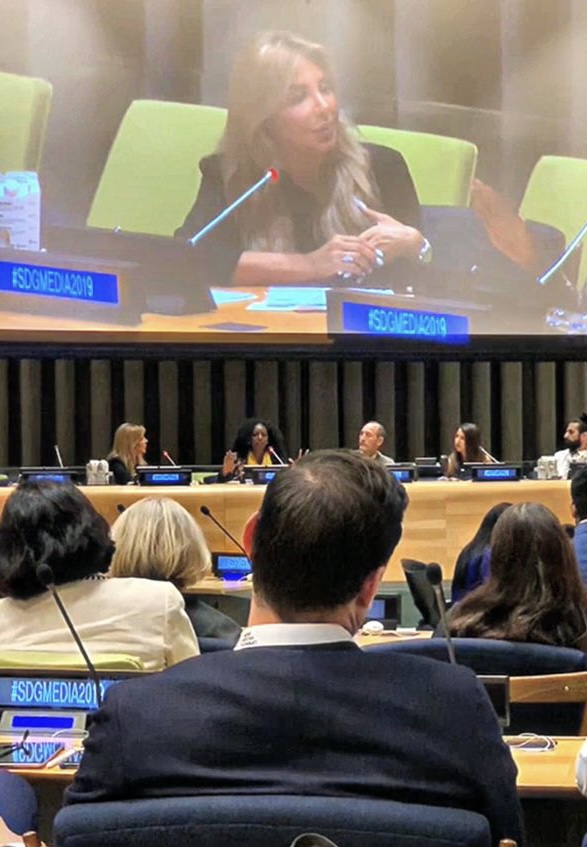
N: I speak for the UN on their Sustainable Development Goals (SDGs). 172 countries have committed to 17 goals with the aim of making the world a better place for future generations by 2030. My role is to raise awareness not only of these goals but of the consequences if we don’t achieve them.
G: We have 8 years to achieve these goals, how realistic is it that they will be achieved?
N: We aren’t saying there will be universal access to education by 2030 but we have to start somewhere. This work began years ago, we have achievable targets, we are making inroads, particularly thanks to younger people who will go on to educate future generations. There is a lot of work to do but I am hopeful. I have young children, I want them to inherit a more peaceful and prosperous planet.
G: There’s a rumour that you were interviewed for Real Housewives of Dubai…
N: Ha ha really? I was interviewed but I have a lot on.
G: What’s next for you?
N: It’s early days so I can’t say much but I hope to do a big project in Saudi. Stay tuned!
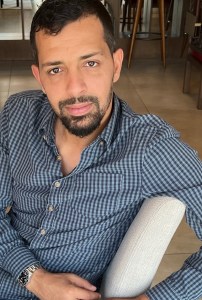
Ziryab Alghabri is a photographer/mixed-media artist based in Dubai. His subject matter is varied and unconventional, from the ethereal landscapes of some of the most remote parts of the Middle East, to Dubai’s modern cityscape captured from a gyrocopter, to simple emotive videos of Dubai’s unsung heroes, the delivery drivers.
Ziryab is currently working on a photographic collection for OpenSea, the world’s largest decentralised peer-to-peer NFT marketplace.*
G: Tell me about the new project?
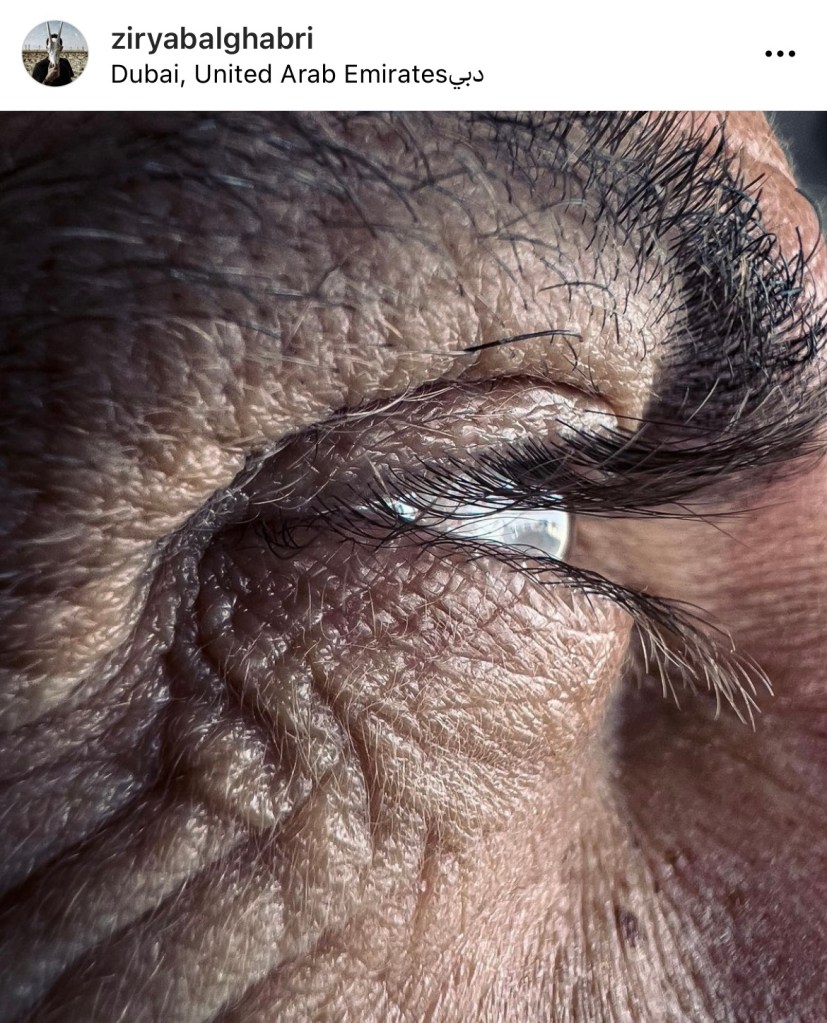
Z: I am photographing the unique markings that women have on their face or body, like a scar, or a stretch mark, birthmark or a tattoo.
G: Why this theme?
Z: Body markings sometimes have important stories attached. I want to highlight the beauty of imperfection or difference. I think that images have become so filtered and generic now, flaws are hidden when they should be shown, celebrated, normalised.
G: Do you have any scars?
Z: I’ve lived in Dubai for a long time but I was born in Yemen so… I have a physical scar on my neck. I ran into barbed wire as a kid.
G: You are looking for people with scars to photograph for this new exhibition?
Z: Yah, any female in Dubai, any age, any ethnicity. If you have something unique on your skin, I’d like to photograph that, make it art.
G: When and where?
Z: If someone is interested, contact me through my IG. I can photograph their marking wherever and whenever they feel comfortable.
G: Do women need to show their faces as part of the photograph?
Z: No, they can be anonymous. If they would like to share a story about their unique feature or marking, it would be interesting to have the backstory.
G: Why do you chose to exhibit and sell your work on OpenSea, an NFT platform?
Z: It’s the future of art collecting! Using this format preserves the rights of the artist and the purchaser as the contract is built on block chain technology. Everything is transparent, the art is accessible to everyone and it enables artists to showcase their work to a global audience.
G: Is there payment for being photographed for this project?
Z: Not up front. If the digital photograph is purchased and the subject matter sets up a wallet, there can be a % fee.
G: How do people who are interested in featuring in this project contact you?
*If you’re wondering, NFT stands for Non-Fungible Token which is a one-off collectible digital thing, like an avatar, music or a piece of art. Each NFT is unique. OpenSea is a platform where people can buy, sell and auction NFTs.
For 26 years the Sharjah Biennial has presented innovative contemporary art from local and international artists, designed to enrich the cultural landscape of the region.
Since its inauguration in 1993, the Biennial has grown from humble beginnings into an internationally acclaimed event and a vital platform for global art and the exchange of ideas. The Biennial features artworks and commissions in the form of large-scale public installations, films, interactive media, performances, sculptures, drawings, moving images, music and paintings.
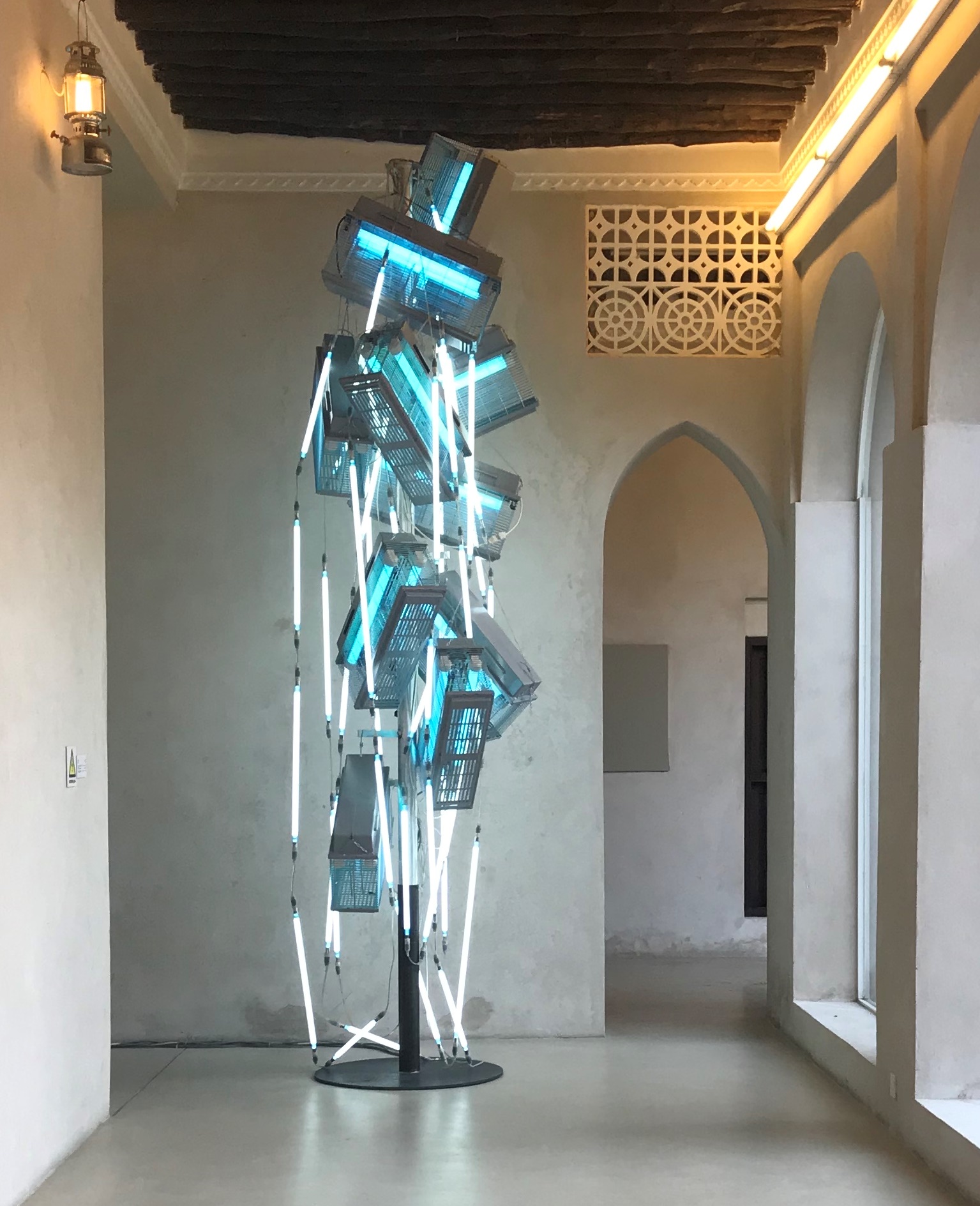
Emissaries by Ian Cheng
In its early editions, the Biennial selected artists to represent each participating country. More recently the focus has transcended geographical borders, moving away from the artist’s location and towards the individual artists themselves with a focus on how the artist engages with their work, within the framework of a curatorial theme.
Historically, Biennial themes have reflected upon regional and world events. Biennial 8 Still Life: Art, Ecology, and the Politics of Change examined the growing environmental challenges in the world due to excessive urban development, political ambitions and the depletion of natural resources. The relationship between the Arab world and other non-Western worlds was re-examined in Biennial 11 Towards a New Cultural Cartography and Biennial 12 The past, the present, the possible explored the emirate’s potential in the context of its history, its transition and an imagined future.
The Flycatcher by Astrid Klein
The benefits of the Sharjah Biennial for Sharjah and collaborating partner cities has been undeniably positive. Art in all its forms has an outlet and is flourishing. The emirate is a recognized center of culture and renowned for nurturing emerging artists, expanding horizons of knowledge and fostering originality and creativity in art through outreach programs, residencies, commissions, education programs and exhibitions.
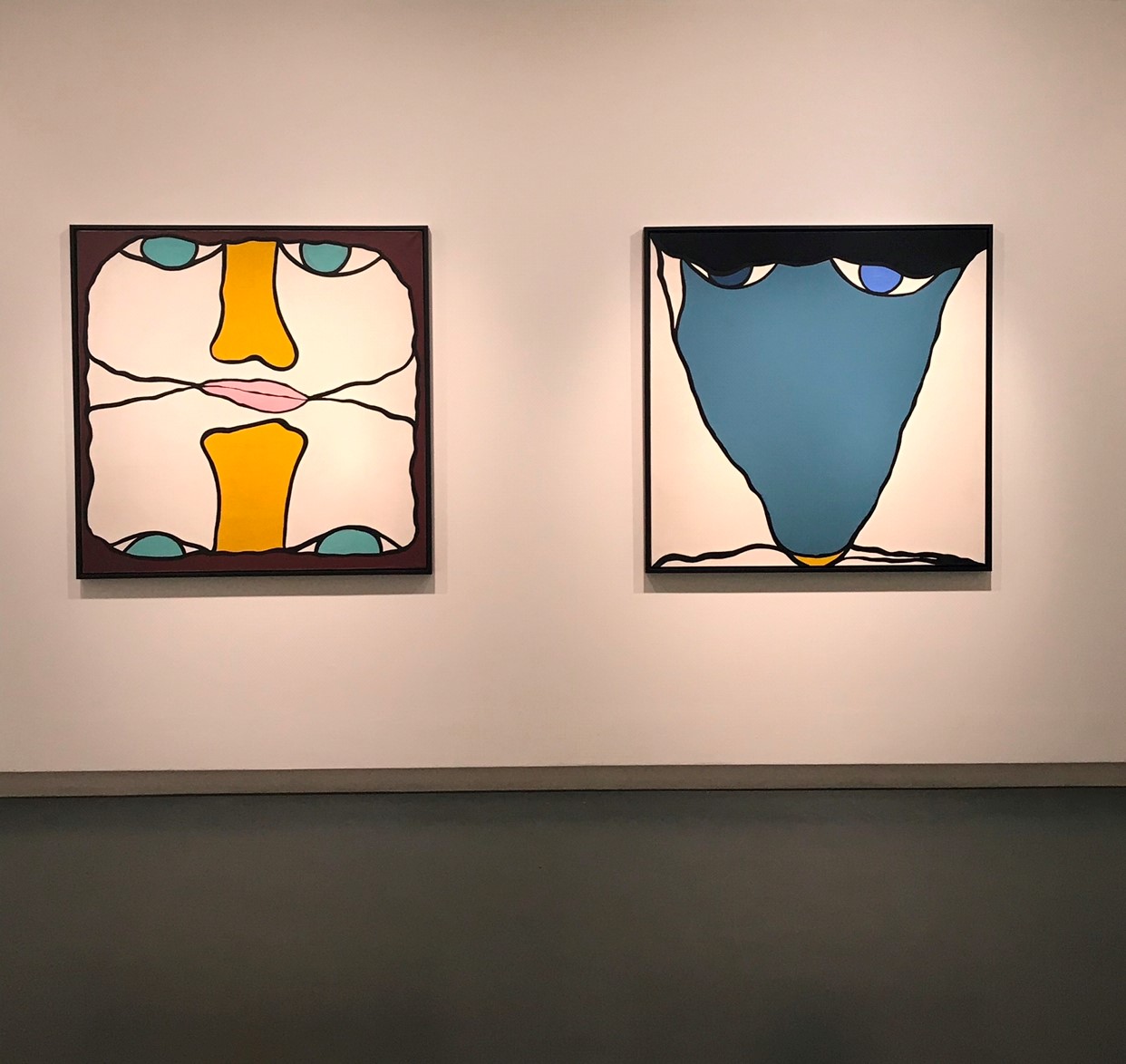
Huguette Caland
The Biennial offers an artistic insight into who we are as human beings and how we see our world. Assumptions about societal values are challenged in a manner which exposes hypocrisy, ignorance and uncertainty. Such a heritage will appeal to those who seek answers to the difficult questions that we face as world citizens within political boundaries.
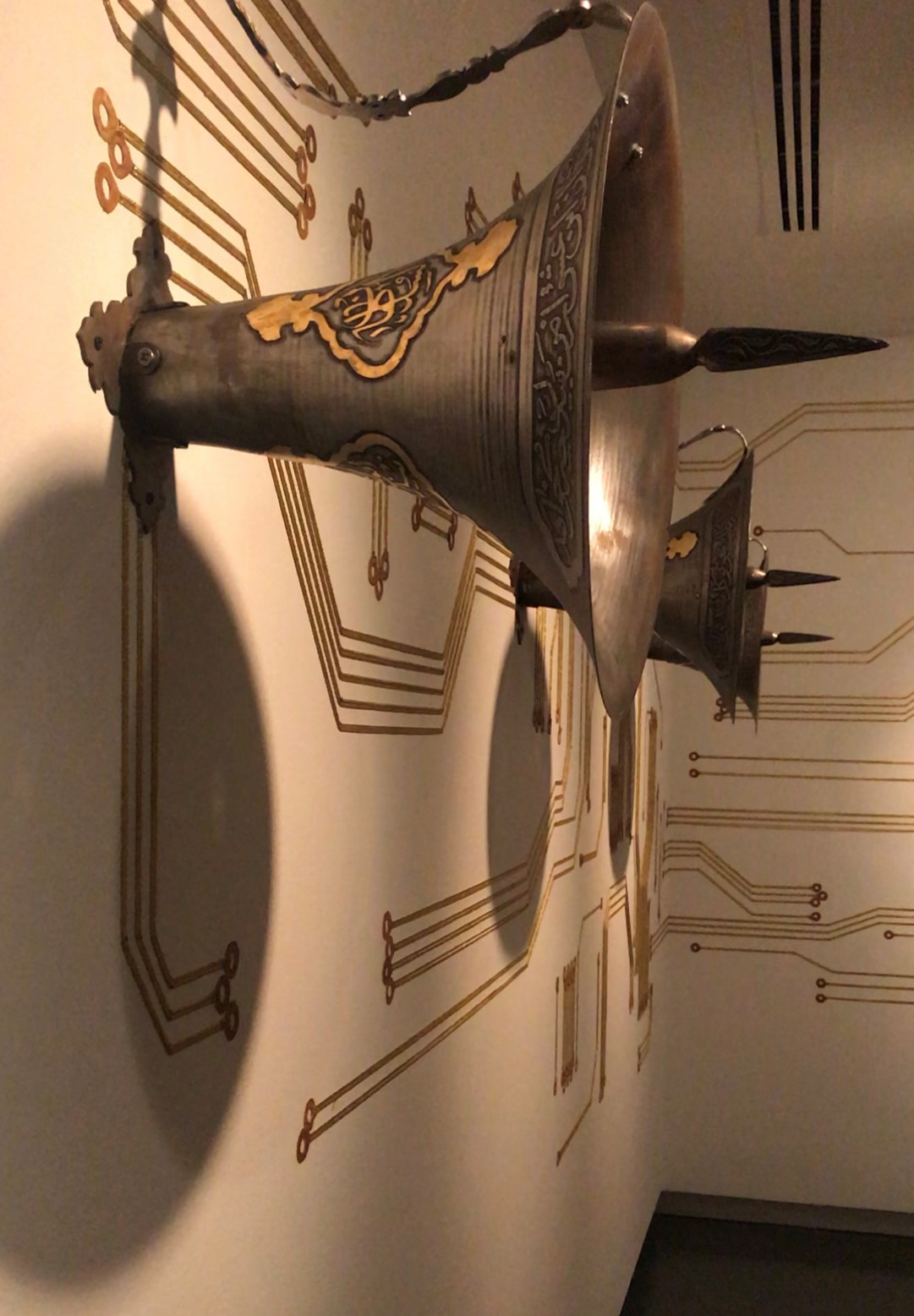
Urbicide by Khadim Ali
The enduring legacy of successive Biennials will be to encourage dialogue and connectivity between those fortunate enough to be a part of, or visitor to, the exhibitions. The dedication of the city and the Trustee of the Sharjah Foundation to the quality of this exhibition makes this Biennial the most significant and engaging showcase for contemporary art in the Middle East.
Sharjah Biennial 14 runs until the 10 June 2019. To find out more, please go to Visit Sharjah
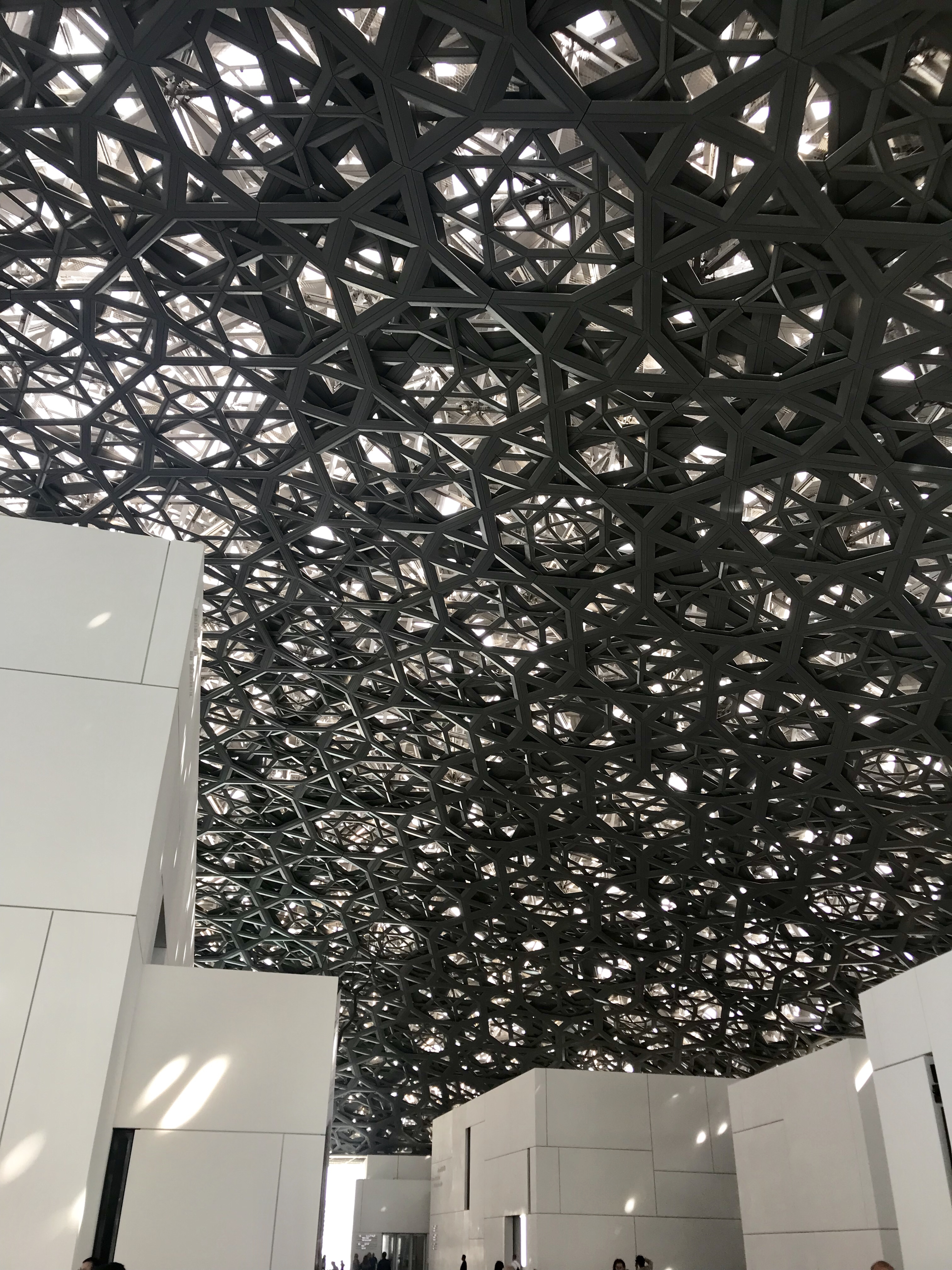
What do you get when you cross a French institution with Abu Dhabi’s bold vision of cultural inclusiveness and progressive architecture?
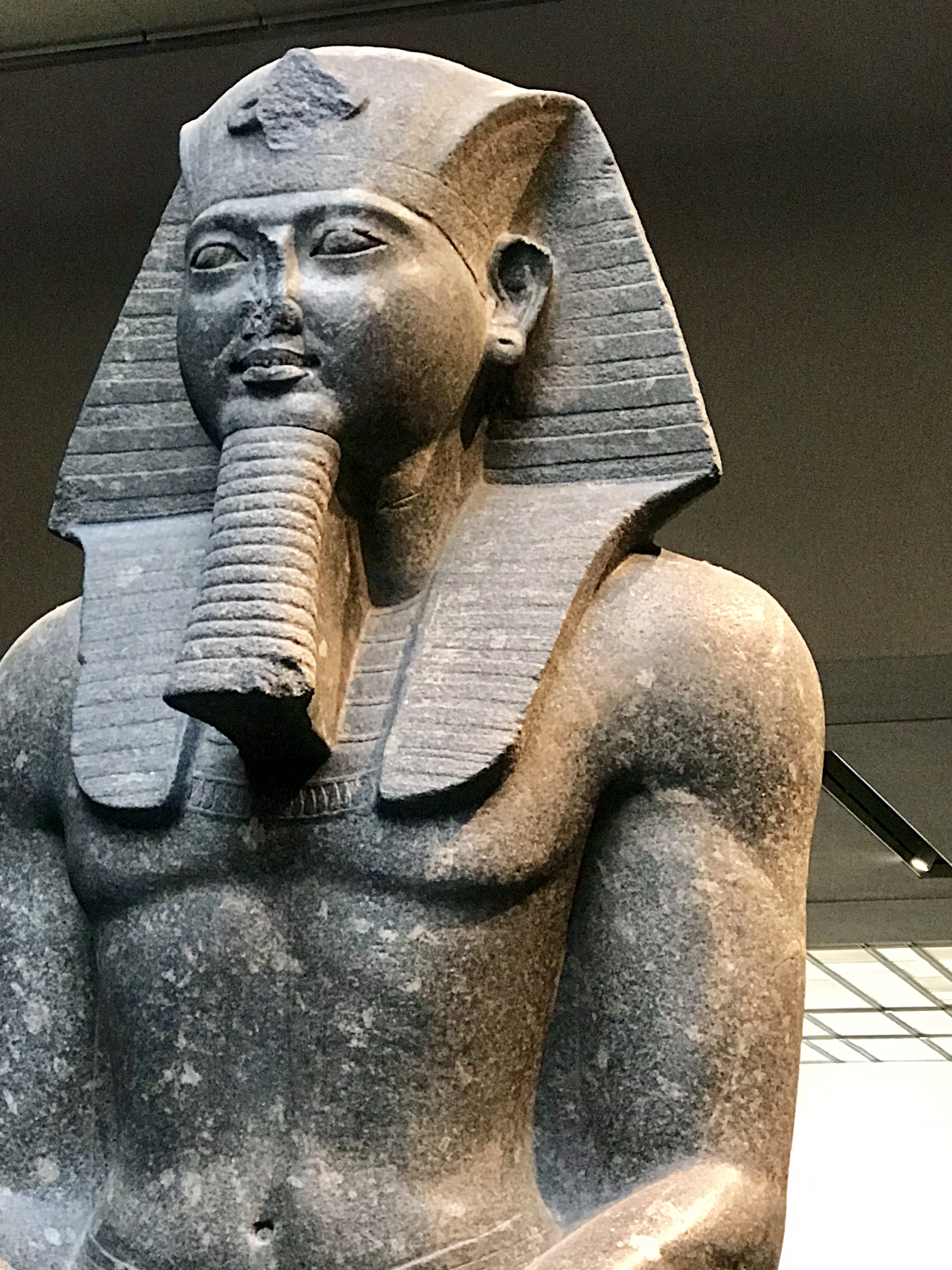
In a cross-country collaboration, Louvre Abu Dhabi opened in 2017 and like it’s namesake, not only is the museum itself a modern masterpiece but it houses some of the best art in the world.
The museum is divided into 12 galleries that showcase pieces from pre-history through to contemporary art. The pieces are curated by chronology rather than geography, fostering a unified multicultural version of history that helps to bridge the gap between East and West.
Not only is Louvre Abu Dhabi a place of awe and contemplation, it promotes education and inclusiveness and at a time when there is too much stupidity and intolerance in the world, isn’t that refreshing 🙌🏻


 Georgina Clark